
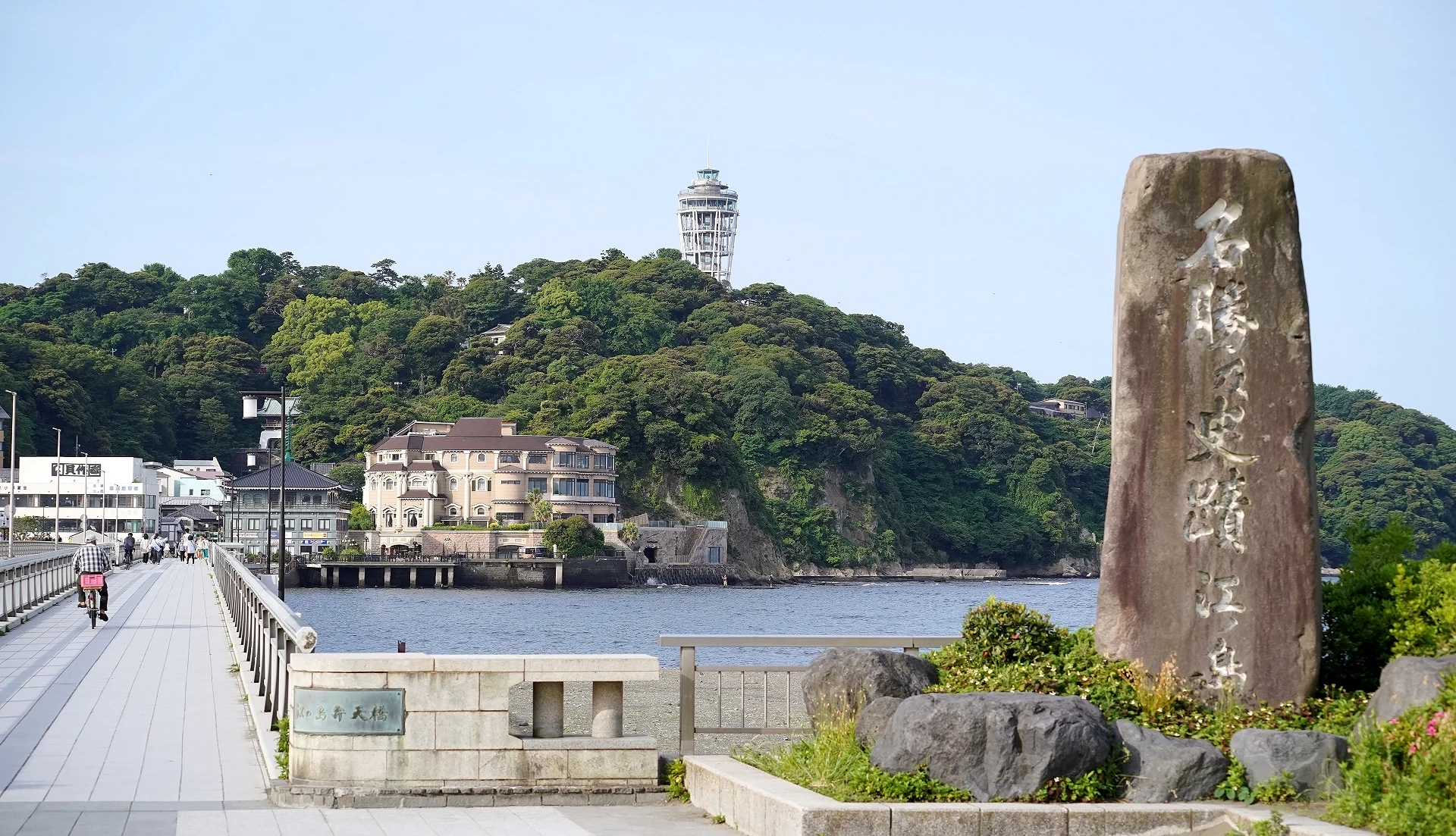
Located just over an hour from Tokyo, Enoshima in Kanagawa Prefecture is one of the Shonan beaches most loved by Tokyo residents. Below is a complete guide to transportation, must-see attractions, must-try food, recommended souvenirs, accommodation, summer and winter illumination events, and suggested day-trip itineraries. For the most detailed Enoshima travel guide, this is the only article you need!

Enoshima is located in Fujisawa City, Kanagawa Prefecture, and is one of the closest popular beach destinations to Tokyo. The island combines nature and history, with attractions such as Enoshima Shrine, which enshrines one of Japan’s Three Great Benzaiten, the Enoshima Sea Candle observation lighthouse, and the Iwaya caves. Along the shopping street, you will also find must-try local specialties such as shirasu dishes and freshly pressed octopus crackers. Enoshima is also known as a cat island, where lazy, adorable cats can often be seen sunbathing throughout the island. Their relaxed presence perfectly matches the laid-back atmosphere and attracts many cat lovers and photographers. It is a rare seaside getaway near Tokyo where visitors can enjoy the ocean breeze and delicious food.
Classic Enoshima Attractions
Enoshima Aquarium

Enoshima Aquarium, which showcases marine life from Sagami Bay, is located near Katase-Enoshima Station across the water from Enoshima. Opened in 2004, it offers outstanding views of Mount Fuji and Enoshima. It is not only a popular date spot for local couples but has also appeared in many Japanese television dramas. The aquarium is themed around Sagami Bay and the Pacific Ocean and is divided into 14 exhibition areas. Highlights include the 9-meter-high, 1,000-ton Sagami Bay Tank, which uses a wave-making system to realistically recreate the marine ecosystem of Sagami Bay, the photogenic Jellyfish Fantasy Hall, and a popular dolphin show. Whether you are visiting on a date or with children, it is an excellent place to spend several hours.
Address: 2-19-1 Katase Kaigan, Fujisawa City, Kanagawa Prefecture
Opening Hours: 9:00–17:00 (Hours may vary by season. Check the official website before your visit.)
Admission: Adults ¥2,800; high school students ¥1,800; elementary and junior high school students ¥1,300; children aged 3 and over ¥900
Transportation: 3-minute walk from Katase-Enoshima Station on the Odakyu Line
Katase Coast

Katase Coast is divided by Enoshima Bridge into Katase Higashihama Beach and Katase Nishihama Beach. On clear days, both sides offer views of Enoshima and Mount Fuji. During summer, this is a famous swimming area that attracts many visitors who enjoy surfing and other water activities, making it one of the most popular destinations on the Shonan Coast. Since it is located near the entrance to Enoshima Bridge, stop here to walk in the surf and cool down before crossing to the island.
Katase Higashihama Beach
Address: 1-15 Katase Kaigan, Fujisawa City
Transportation: 5-minute walk from Katase-Enoshima Station on the Odakyu Line
Benzaiten Nakamise Shopping Street

After passing through the bronze torii gate, you will enter Benzaiten Nakamise Shopping Street, the liveliest area of Enoshima. Restaurants, food stalls, and souvenir shops line both sides of the street all the way to the entrance of Enoshima Shrine. The area is filled with seafood dishes and snacks made from Enoshima specialties, as well as long-established Japanese confectionery shops such as Enoshima Monaka, which opened in 1902 and has more than 120 years of history. It is truly Enoshima’s food paradise, where it is difficult to stop eating.
Address: 1-4 Enoshima, Fujisawa City, Kanagawa Prefecture
Transportation:
① 10-minute walk from Katase-Enoshima Station on the Odakyu Line
② 15-minute walk from Enoshima Station on the Enoden Line
③ 15-minute walk from Shonan-Enoshima Station on the Shonan Monorail Enoshima Line
Enoshima Shrine

Enoshima Shrine, the island’s most representative shrine, enshrines one of Japan’s Three Great Benzaiten. Founded in AD 552, it has a history of more than 1,000 years, and traces of its original form can still be seen inside Enoshima’s natural caves. Enoshima Shrine consists of Hetsunomiya, Nakatsunomiya, and Okutsunomiya. Below are the main highlights of each shrine.
Visit Hetsunomiya to Pray for Blessings
Hetsunomiya, established by Minamoto no Sanetomo, enshrines Tagitsuhime-no-Mikoto, one of the three Munakata goddesses. The Hoanden beside it houses two extremely rare statues of Benzaiten. One is Myoon Benzaiten, a nude figure playing a musical instrument that was created during the Kamakura period. The other is Happi Benzaiten, an eight-armed figure holding numerous weapons. The grounds also contain the White Dragon King Pond, where visitors can wash money. It is said that money washed in the clear water flowing here will multiply, so try washing a few coins.
Pray for Romantic Fortune at Nakatsunomiya
Nakatsunomiya enshrines Ichikishimahime-no-Mikoto, a deity associated with relationships and matchmaking. Its vivid red shrine buildings are especially popular among women, making it a famous spiritual destination for romance. The ema prayer plaques feature designs representing five forms of beauty: beautiful skin, fair skin, a beautiful smile, a beautiful figure, and beautiful hair. Matching omamori charms are also available, making this a popular stop for beauty-conscious visitors.
Okutsunomiya, Guardian of the Sea
Located at the summit, Okutsunomiya enshrines Takiribime-no-Mikoto, the eldest of the three goddesses and a deity who governs the sea. The worship hall ceiling features a remarkably lifelike painting known as the Turtle Watching in All Directions. Beside Okutsunomiya is Ryugu Shrine, dedicated to the dragon deity. From here, you can also follow the stairs down to Enoshima’s natural caves.
Address: 2-3-8 Enoshima, Fujisawa City, Kanagawa Prefecture
Opening Hours: 8:30–16:30
Admission: Enoshima Shrine grounds are free; Hoanden admission is ¥200
Enoshima Samuel Cocking Garden

Enoshima Samuel Cocking Garden occupies the remains of a Japanese-Western-style garden and greenhouse built in 1862 by British merchant Samuel Cocking. Covering more than 10,000 square meters, the garden contains tropical plants from southern regions and seasonal flowers and was once the largest greenhouse in the East. In addition to the greenhouse ruins and tropical garden, the famous Enoshima Sea Candle observation lighthouse is located within the grounds. The garden also includes a plaza, cafés, shops, galleries, and other cultural facilities. It is an excellent place to enjoy a sunset with Mount Fuji silhouetted in the distance from a café in the early evening. Seasonal illuminations are held at night, creating a highly romantic atmosphere.
Climb the Enoshima Sea Candle: Mount Fuji Is Visible on Clear Days
The offshore lighthouse visible whenever you look toward Enoshima is the famous Enoshima Sea Candle landmark, located inside Enoshima Samuel Cocking Garden. The tower is 59.8 meters tall, with the observation deck positioned approximately 101 meters above sea level. It was built in 2003 to commemorate the 100th anniversary of the Enoden railway.
An Observation Deck with 360-Degree Views of Kamakura and Shonan
Take the elevator to the top of the Enoshima Sea Candle. The upper level includes indoor and outdoor areas, and the circular observation deck offers unobstructed 360-degree views over Shonan, Fujisawa, and Kamakura. Mount Fuji can also be seen in clear weather. The admission ticket is valid for the entire day, so after enjoying the daytime scenery, you can return in the evening for the night view.
※ Separate admission is required for the Enoshima Sea Candle. Holders of the Odakyu Enoshima-Kamakura Freepass receive a 10% discount on the regular price.
Enoshima Samuel Cocking Garden and Enoshima Sea Candle
Address: 2-3-28 Enoshima, Fujisawa City, Kanagawa Prefecture
Opening Hours: 9:00–20:00
Admission: Enoshima Samuel Cocking Garden ¥500 after 17:00; Enoshima Sea Candle ¥800
Lover’s Hill and the Bell of Ryuren

Lover’s Hill and the Bell of Ryuren were created based on Enoshima’s romantic legend of the celestial maiden and the five-headed dragon. According to the story, the five-headed dragon lived in a deep lake in Kamakura and caused natural disasters every day, bringing great suffering to local people. One day, a beautiful celestial maiden descended from the heavens and attracted the dragon’s affection. After initially being rejected, the dragon began performing good deeds and helping others. The maiden was eventually moved by the change, and the two became a couple. This legend of lovers finally coming together attracts many couples and married partners. It is said that if lovers attach a padlock beneath the bell together, their relationship will last forever and they will never be separated. Bring your partner and experience it together.
Address: 2-5 Enoshima, Fujisawa City
Transportation: Approximately 30 minutes on foot from Katase-Enoshima Station
Enoshima Iwaya Caves

The Enoshima Iwaya Caves are sea-eroded caves located at the lowest point of Enoshima. Buddhist masters such as Kobo Daishi and Nichiren are said to have practiced ascetic training here, and the caves are therefore regarded as the birthplace of religious worship on Enoshima. There are two caves. The First Iwaya is said to connect with the ice cave at Mount Fuji and is associated with the origins of Enoshima Shrine, while the Second Iwaya is considered sacred in the legend of the dragon deity. Before entering the First Iwaya, visitors can receive a handheld candle. The flickering light, stone statues, and explanations on the cave walls create the feeling of entering a mysterious world.
※ Admission is required. Holders of the Odakyu Enoshima-Kamakura Freepass receive a 10% discount on the regular price.
Address: Enoshima 2, Fujisawa City
Admission: Adults (junior high school age and above) ¥500; elementary school students ¥250
Transportation: Approximately 30 minutes on foot from Katase-Enoshima Station
Chigogafuchi Abyss

Chigogafuchi Abyss is located at the southwestern end of the island. Years of wave erosion combined with crustal uplift created a dramatic landscape of cliffs resembling folding screens. The name has a sad origin. A young acolyte named Shiragiku from Tongakubo, also known as Shojoin, one of Kamakura’s Tsurugaoka Twenty-Five Temples, is said to have ended his life here, leading the site to be named Chigogafuchi. At sunset, visitors can see the full outline of Mount Fuji, and the beautiful scenery earned the site a place among the 50 Scenic Views of Kanagawa. Be sure to visit around dusk, when the spectacular landscape provides endless photo opportunities.
Address: 2-5-2 Enoshima, Fujisawa City
Transportation: Approximately 30 minutes on foot from Katase-Enoshima Station
Average Monthly Sunset Times in Enoshima
Would you like to watch the sunset at Chigogafuchi Abyss? Below is a reference guide to the average sunset time for each month. Actual sunset times vary by several minutes each day, so check the precise time for the date of your visit.
| month | Sunset time |
|---|---|
| January | 16:41 |
| February | 17:10 |
| March | 17:38 |
| April | 18:03 |
| May | 18:28 |
| June | 18:52 |
| July | 18:47 |
| August | 18:11 |
| September | 18:11 |
| October | 17:28 |
| November | 16:49 |
| December | 16:31 |
Enoshima Attraction Map

Must-Try Food in Enoshima
Nearby Restaurants
Enoshima Koya: Two Popular Breakfasts—Fisherman’s Soup and Raw Egg Rice

Enoshima Koya is one of the most popular restaurants on Katase Coast in Fujisawa and is loved by locals for dishes prepared with fresh seafood caught in Sagami Bay that same day. Two breakfast sets available only from 8:00 to 10:30 are especially recommended. The Fisherman’s Soup Set features a rich fish broth simmered from fish bones, fried fish, and several kinds of fresh sashimi, making it essential for seafood lovers. Another favorite is the Kinmedai Simmering Sauce Raw Egg Rice Set, made by mixing a raw egg with freshly shaved bonito flakes and a sweet-savory sauce from simmered splendid alfonsino instead of regular soy sauce. Enjoying breakfast while looking out over the coast is a quintessential Shonan experience.
Address: 2-20-12 Katase Kaigan, Fujisawa City, Kanagawa Prefecture
Opening Hours: 8:00–20:00
Price Range: Fisherman’s Soup Set ¥1,940; Kinmedai Simmering Sauce Raw Egg Rice Set ¥1,540
Transportation: 2-minute walk from Katase-Enoshima Station on the Odakyu Line
A Taste of Hawaii! ALOHA TABLE Shonan

ALOHA TABLE, whose original location is on Waikiki Beach in Hawaii, can now also be enjoyed on Katase Coast. Located only one minute from Katase-Enoshima Station, this lively Western-style restaurant offers ocean views. Its classic signature dish is the Hawaiian Loco Moco, featuring a sweet, rich sauce simmered with mushrooms, onions, and other vegetables, served with a pan-seared hamburger steak and fried egg. It was ranked No. 1 in Hawaii’s loco moco category for three consecutive years and is so satisfying that you will want to order it again. In addition to loco moco, groups can share platters of Japanese-inspired side dishes. The colorful and photogenic cocktails and juices are also recommended.
Address: 2-17-17 Katase Kaigan, Fujisawa City, Kanagawa Prefecture
Opening Hours: 10:00–21:00
Price Range: Hawaiian Loco Moco ¥1,980; Hawaiian Loco Moco Platter ¥2,680
Transportation: 2-minute walk from Katase-Enoshima Station on the Odakyu Line
Must-Try Food on Enoshima Island
Seafood Rice Bowls at Tobiccho

For the most authentic and freshest Enoshima seafood, do not miss the famous seafood rice bowl restaurant Tobiccho. The word tobiccho is a local Enoshima expression referring to coastal rocks and rocky shorelines, and the restaurant uses this distinctive dialect as its name. Here, visitors can enjoy a range of seafood bowls centered on Enoshima’s famous shirasu. The best-known dish is the Tobiccho Bowl, which contains nearly ten kinds of sashimi. It offers a generous selection of seasonal seafood in addition to shirasu and is excellent value, making it the restaurant’s No. 1 most popular dish.
Address: 1-6-7 Enoshima, Fujisawa City, Kanagawa Prefecture
Opening Hours: Weekdays 11:00–21:00 (L.O. 20:00); weekends and holidays 11:00–21:00 (L.O. 20:30)
Price Range: Tobiccho Bowl ¥2,530
Transportation: 15-minute walk from Katase-Enoshima Station on the Odakyu Line
Enoshima-tei

When it comes to cooked Enoshima specialties, the Enoshima Rice Bowl at Enoshima-tei is the standout choice. Enoshima-tei opened in 1909 and has more than a century of history. Its original Enoshima Rice Bowl is made with clams simmered in soy sauce and sugar, combined with onions and softly cooked egg in a style similar to oyakodon. The mixture is generously served over steaming white rice and finished with a raw egg. The fluffy egg and naturally sweet seafood flavors make it easy to finish the entire bowl in moments.
Address: 2-6-5 Enoshima, Fujisawa City, Kanagawa Prefecture
Opening Hours: Weekdays 10:30–18:00 (L.O. 17:30); weekends and holidays 10:30–19:00 (L.O. 18:30)
Price Range: Enoshima Rice Bowl ¥1,540
Transportation: 25-minute walk from Katase-Enoshima Station on the Odakyu Line
A Whole Octopus Pressed Flat! The Extremely Popular Octopus Cracker

The famous Enoshima octopus cracker from ASAHI Honten is sold on Benzaiten Nakamise Shopping Street. A whole fresh octopus is placed under pressure and flattened into a cracker. Served hot, it is crisp and fragrant, and you can still recognize the shape of the octopus before it was pressed. It is both delicious and unusual, making it difficult to stop after one bite.
ASAHI Honten
Address: 1-4-8 Enoshima, Fujisawa City, Kanagawa Prefecture
Opening Hours: 9:00–18:00; closed Thursdays
Price Range: Regular octopus cracker ¥500; extra-octopus version ¥1,100
Transportation: 15-minute walk from Katase-Enoshima Station
A New Idea from a Historic Shop: Ice Cream Monaka in Three Shapes and Flavors

The Ice Cream Monaka from century-old Kinokuniya Honten is also extremely popular. Choose from red bean, matcha, or vanilla ice cream, then pair it with a monaka wafer shaped like a scallop, turban shell, or clam. It is refreshing, delicious, and adorable.
Kinokuniya Honten
Address: 2-1-12 Enoshima, Fujisawa City, Kanagawa Prefecture
Opening Hours: 8:30–18:00; closed Wednesdays
Price Range: Ice Cream Monaka ¥400 each
Enjoy a Drink on the Open-Air Terrace at THE SUNSET TERRACE

In addition to enjoying the scenery from the observation deck, take time to relax at THE SUNSET TERRACE, which extends from the lower level of the Enoshima Sea Candle. As the name suggests, this open-air terrace offers beautiful sunset views over Sagami Bay. Drinks and snacks purchased from the café and food stalls on the first floor can be brought here, so arrive early and secure a seat.
THE SUNSET TERRACE
Address: 2-3-28 Enoshima, Fujisawa City, Kanagawa Prefecture (Take the stairs beside the Enoshima Sea Candle entrance to the second floor.)
Opening Hours: 15:00–19:00
Food Near Fujisawa Station
Many shops on Enoshima close relatively early. If you plan to eat after watching the sunset over Mount Fuji, enjoying the night view, or seeing seasonal illuminations in the evening, the area around Fujisawa Station is recommended. It allows more flexibility in your schedule, offers a wide variety of restaurants and izakaya, and provides convenient transportation for the journey home. Below are several additional dining options near Fujisawa Station.
Sushi Jingoro

Sushi Jingoro is a famous restaurant loved by locals, and even local residents need luck to secure a reservation. Travelers who want to avoid the standard tourist route should strongly consider this long-established shop for nigiri sushi and seafood rice bowls. Affordable lunch and dinner menus are available, along with menus in Chinese, English, and Korean, making ordering easy for international visitors. The Local Seafood Nigiri Sushi sampled during the visit featured exceptionally fresh sashimi and a precise balance with the vinegared rice, creating a deeply satisfying bite. The restaurant remains open until 22:00 (L.O. 21:00). Its location near the station, convenient transportation, uncrowded atmosphere, and authentic craftsmanship make it an excellent choice.
Address: 3F Jingoro Building, 1-4-6 Kugenuma Ishigami, Fujisawa City, Kanagawa Prefecture
Opening Hours: 11:30–14:00 (L.O. 13:30) / 17:00–22:00 (L.O. 21:00); closed Mondays and possibly on national holidays
Price Range: Local Seafood Nigiri Sushi ¥1,400
Transportation: Approximately 5 minutes on foot from Fujisawa Station
Ajinokokuya Fujisawa

Ajinokokuya is a classic restaurant that has operated in Fujisawa for more than 70 years since the Showa era. Its Chinese-style ramen and other dishes are loved by local residents. Even at an off-peak time such as 14:30, regular customers still line up outside, demonstrating its popularity. The interior preserves a Showa-era atmosphere and immediately creates a comfortable, relaxing feeling. The Chinese-style char siu ramen ordered during the visit had a light broth, the fried rice carried a strong wok aroma, the spring roll wrapper was crisp, and each dumpling released plenty of flavorful juice. Travelers who want to experience everyday local life and discover what residents actually eat should try these nostalgic classics.
Address: B1F Diamond Building, 2-1-3 Minami-Fujisawa, Fujisawa City, Kanagawa Prefecture
Opening Hours: 11:00–20:00 (L.O. 19:30; closing days follow the Diamond Building schedule)
Price Range: Char Siu Ramen ¥770; fried rice ¥880
Transportation: Approximately 2 minutes on foot from Fujisawa Station
Charcoal Yakiniku TAJIMA

Charcoal Yakiniku TAJIMA is a long-established restaurant that has been rooted in Fujisawa for more than 30 years and is deeply loved by local residents. It requires a short walk from the station, but this also allows diners to avoid the noise of the tourist areas and enjoy a calm, leisurely meal. The restaurant has 44 standard seats and a private room that can accommodate approximately 20 people, making it suitable for family trips and larger groups. Specializing in charcoal-grilled yakiniku, the restaurant cuts every piece of meat by hand. The carefully selected thickness brings out the tenderness, juiciness, and aroma of each cut. During the visit, we ordered the reasonably priced set available for two or more people, starting from ¥3,700 per person, together with a three-variety wagyu platter and cold noodles. The portions were generous, and the wagyu platter offered several flavors at excellent value. Meat lovers should add this restaurant to their list.
Address: 9-6 Asahicho, Fujisawa City, Kanagawa Prefecture
Opening Hours: 11:30–14:30 (L.O. 14:00), 17:00–22:00 (L.O. 21:30); closed Thursdays
Price Range: Value Set from ¥3,700 per person
Transportation: Approximately 8 minutes on foot from the north exit of Fujisawa Station
Recommended Enoshima Souvenirs
Creative Chirimen Fuyusha Enoshima Store

A rare visit to Enoshima calls for souvenirs with distinctive local character. Creative Chirimen Fuyusha is a Japanese chain specializing in traditional-style accessories, with stores in tourist destinations including Enoshima, Fushimi in Kyoto, and Dogo Onsen in Ehime. The shop offers a wide range of Japanese-style goods such as chopsticks, chopstick rests, small fabric bags, handkerchiefs, noren curtains, and adorable decorations. Whether purchased as gifts or for personal use, the items have a strong Japanese aesthetic and excellent commemorative value.
Address: 2-1-10 Enoshima, Fujisawa City, Kanagawa Prefecture
Opening Hours: 10:00–18:00
Nakamuraya Yokan Shop

Have you ever tried nori yokan with the flavor of the sea? Nakamuraya Yokan Shop was founded in 1902 and is a century-old Enoshima business with more than 120 years of history. The third-generation owner, Nakamura Sukejiro, once noticed seaweed clinging to the rocky shore of Enoshima. Inspired by the sight, he believed the seaweed was a gift from Benzaiten and decided to incorporate it into yokan made from white kidney beans. It has since become the shop’s unique signature product. Another item, Meoto Manju, contains a smooth filling made from Hokkaido red beans and comes in brown and white varieties. Both received gold awards at the National Confectionery Exposition. Dessert lovers should not miss them.
Address: 2-5-25 Enoshima, Fujisawa City, Kanagawa Prefecture
Opening Hours: 9:00–18:00
ENOSHIMA PUDDING
Pudding is loved by both adults and children. The defining feature of ENOSHIMA PUDDING is the addition of barley produced in Shonan to the egg yolks, milk, and fresh cream used in the pudding. This adds a natural and wholesome element, while the dessert remains light rather than overly sweet, making it feel less indulgent. It has become a well-known modern local dessert. In addition to the original flavor, there is a version topped with barley jelly for additional texture. The bottle is also attractively designed and worth keeping after the pudding is finished.
Address: 1-11-27 Katase Kaigan, Fujisawa City, Kanagawa Prefecture
Opening Hours: 10:00–17:00; until 17:30 during summer
Recommended Accommodation in Enoshima
Iwamotoro

Iwamotoro is a historic ryokan that has witnessed approximately 850 years of Enoshima’s development from the Kamakura period to the present day. Its predecessor was Iwamotobo, a Kamakura-period temple responsible for managing the Enoshima Iwaya caves and the inner temple of Enoshima Shrine. It later became Iwamotoin and held considerable religious, political, and economic authority on the island. After 1874, it was renamed Iwamotoro and has continued operating as a ryokan ever since. It has been selected by numerous members of the Imperial Family during their visits to Enoshima. The Roman-style bath built in 1930 remains preserved and is registered as a National Tangible Cultural Property. This is one of Enoshima’s most historically significant places to stay.
Address: 2-2-7 Enoshima, Fujisawa City, Kanagawa Prefecture
BREATH HOTEL

BREATH HOTEL is located along Shonan Kaigan Park, a short distance from Enoshima. Its front-row seaside position gives every guest room an unobstructed view of Sagami Bay. Guests can fall asleep to the sound of the waves, while Bad Gastein mineral stones from Austria are placed throughout the property and used to filter the hotel’s tap water, creating a sense of nature’s restorative power even through the water. The rooms and public spaces follow a minimalist design intended to help guests relax by experiencing a simple, understated sense of breathing in harmony with nature. It is a hotel that places particular emphasis on nature and wellness.
BREATH HOTEL
Address: 1-7-11 Kugenuma Kaigan, Fujisawa City, Kanagawa Prefecture
KINOKUNIYA RYOKAN

Kinokuniya Ryokan is part of a Japanese chain of traditional inns with locations at well-known destinations throughout the country. Its Enoshima property is not located on the island but near Katase Higashihama Beach, only a three-minute walk from the sea. Upon entering, visitors immediately sense the rich history accumulated since the Meiji era. The tatami rooms create a soothing and relaxing atmosphere, and guests can also enjoy seafood dishes prepared with local ingredients. Travelers who prefer traditional Japanese-style rooms may want to consider this ryokan.
Address: 1-13-16 Katase Kaigan, Fujisawa City, Kanagawa Prefecture
ENOSHIMA HOTEL

ENOSHIMA HOTEL is located immediately to the left after crossing Enoshima Bridge onto the island, giving it an outstanding location and beautiful island scenery. Its main feature is the Enoshima Island Spa, which contains Enoshima’s only natural hot spring, rising from a depth of 1,500 meters underground. Indoor and outdoor spa areas include an infinity-style open-air spa, an outdoor waterfall in an artificial cave zone, the grand Taiyo-no-Izumi bath filled with natural light, and the Fuji Umi-no-Yu bath overlooking Sagami Bay and Mount Fuji. The facility also includes a beauty salon and scenic restaurant. It is available not only to hotel guests but also to day visitors. For five consecutive years, the internationally known spa publication SpaFinder selected it among Japan’s Top 10 Spas. Soaking in the hot spring while enjoying the scenery is an exceptionally luxurious way to restore both body and mind.
Address: 2-1-6 Enoshima, Fujisawa City, Kanagawa Prefecture
Classic Enoshima Day-Trip Itinerary
Enoshima Day-Trip Schedule
10:00–12:00 Stroll and have lunch on Enoshima Benzaiten Nakamise Street
↓
12:00–12:15 Ride the Enoshima Escar
↓
12:30–13:00 Visit Hetsunomiya at Enoshima Shrine
↓
13:15–13:45 Visit Nakatsunomiya at Enoshima Shrine
↓
14:00–14:30 Visit Okutsunomiya at Enoshima Shrine
↓
14:45–15:15 Visit the Bell of Ryuren at Lover’s Hill
↓
15:30–17:00 Explore the Enoshima Iwaya Caves
↓
17:00–18:00 Watch the sunset at Chigogafuchi Abyss
↓
18:15–19:30 Enjoy the night view from the Enoshima Sea Candle
↓
20:00–21:45 Return to the Fujisawa Station area for dinner, such as Sushi Jingoro
↓
21:45 onward Return home
Classic Enoshima Day-Trip Itinerary
Recommended Transportation: Travel to Enoshima Station, Shonan-Enoshima Station, or Katase-Enoshima Station, then walk approximately 5–10 minutes to Enoshima
Recommended Duration: 10 hours
Key Highlights: Enoshima Benzaiten Nakamise Street, worship at Enoshima Shrine, sunset at Chigogafuchi Abyss, and the night view from the Enoshima Sea Candle.
Return Transportation: Travel to Fujisawa Station and transfer to your next destination
How to Get to Enoshima
Whether you are in central Tokyo or elsewhere in Kanagawa, such as Yokohama or Kamakura, you can use the following transportation options to reach Enoshima. Most routes first use the JR Tokaido Main Line or Odakyu Railway to reach Fujisawa or Ofuna, followed by a transfer to the Odakyu Line, Shonan Monorail, or Enoden Line. Because the services are operated by different railway companies, the station names vary, but all are within walking distance of one another. Enoshima Station and Shonan-Enoshima Station are close to each other but farther from the island. Katase-Enoshima Station is directly in front of Enoshima Bridge, making it the recommended option for travelers who want to minimize walking.
① From Shinjuku: Approximately ¥650
From Shinjuku Station: Shinjuku Station → Odakyu Line → Fujisawa Station → transfer to the Odakyu Line → Katase-Enoshima Station
※ To take the Odakyu Romancecar directly from Shinjuku to Katase-Enoshima, an additional limited express ticket costing ¥750 is required, bringing the total fare to ¥1,400.
② From Tokyo Station: Approximately ¥1,200
From Tokyo Station ① Tokyo Station → JR Tokaido Main Line → Fujisawa Station → transfer to the Odakyu Line → Katase-Enoshima Station
From Tokyo Station ② Tokyo Station → JR Tokaido Main Line → Ofuna Station → transfer to the Shonan Monorail → Shonan-Enoshima Station
From Tokyo Station ③ Tokyo Station → JR Tokaido Main Line → Fujisawa Station → transfer to the Enoden Line → Enoshima Station
③ From Yokohama: Approximately ¥600
From Yokohama Station ① Yokohama Station → JR Tokaido Main Line → Fujisawa Station → transfer to the Odakyu Line → Katase-Enoshima Station
From Yokohama Station ② Yokohama Station → JR Tokaido Main Line → Ofuna Station → transfer to the Shonan Monorail → Shonan-Enoshima Station
From Yokohama Station ③ Yokohama Station → JR Tokaido Main Line → Fujisawa Station → transfer to the Enoden Line → Enoshima Station
④ From Kamakura: Approximately ¥260
From Kamakura Station: Kamakura Station → Enoden Line → Enoshima Station
Essential Day-Trip Passes
In addition to Enoshima, the Enoden Line toward Kamakura Station passes attractions such as the Kamakurakokomae railway crossing made famous by the opening sequence of Slam Dunk, the National Treasure Great Buddha of Kamakura at Kotoku-in, and hydrangea destinations such as Meigetsu-in and Hasedera. At the terminal, Kamakura Station, visitors can explore the lively Komachi-dori Shopping Street and the historically significant Tsurugaoka Hachimangu Shrine. To visit the major attractions of Kamakura and Enoshima in one day, the following passes offer the best value.
Enoshima-Kamakura Freepass

The Enoshima-Kamakura Freepass offered by Odakyu Railway includes unlimited travel on the Enoden Line between Fujisawa Station and Kamakura Station, unlimited travel on the Odakyu Line between Fujisawa Station and Katase-Enoshima Station, and one round-trip journey between any Odakyu departure station, such as Shinjuku Station, and Fujisawa Station. Travelers departing from Shinjuku in central Tokyo should strongly consider this pass, as it is one of the best-value options available.
Enoden One-Day Pass Noriorikun
Travelers who only need an Enoden one-day pass can purchase Noriorikun. This pass, offered by Enoden, allows unlimited rides and free boarding and alighting between Fujisawa Station, the starting point of the line, and Kamakura Station, the terminal, throughout one day. It is suitable for travelers who are already in Kanagawa Prefecture and do not need a round trip from central Tokyo.
Two Essential Transportation Options on Enoshima for Reducing Walking
Ride the Three-Section Enoshima Escar for an Easier Journey Up the Island
Enoshima may look small, but reaching the summit requires climbing 515 steps. To support tourism, Japan’s first outdoor escalator was installed on the island in 1959. The 106-meter-long escalator covers a vertical difference of 46 meters, is divided into three sections, and operates only uphill. It reduces a 20-minute walk to approximately five minutes, making it extremely convenient.
※ The escalator operates uphill only and requires a separate fee. Holders of the Enoshima-Kamakura Freepass receive a 10% discount on the regular price.
Enoshima Escar
Address: 2-3-9 Enoshima, Fujisawa City, Kanagawa Prefecture
Opening Hours: 8:50–19:05
Fare: Adults ¥500; children ¥250
Transportation: The entrance is located uphill to the left of the entrance to Enoshima Shrine
Take the Bentenmaru Sightseeing Boat Directly to Chigogafuchi Abyss
Walking is not the only way to explore Enoshima. The Bentenmaru sightseeing boat departs from Enoshima Benten Bridge, travels along the island’s coastline, and carries passengers to Chigogafuchi Abyss on the far side of the island. The journey takes only six minutes but provides a completely different perspective from the sea. The famous Iwaya caves are nearby, so travelers planning to visit the caves should consider taking the boat and experiencing Enoshima from another angle.
Bentenmaru Sightseeing Boat
Address: Katase Kaigan, Enoshima 2, Fujisawa City, Kanagawa Prefecture (Benten Bridge boarding point)
Operating Hours: Weekdays 11:00–14:30; weekday service is suspended in January, February, and December; weekends and holidays 10:30–14:30
Fare: Adults (junior high school age and above) ¥400; children aged 6 and above ¥200; children aged 5 and under free
Transportation: The boarding point is located to the right of the entrance to Benten Bridge
※ Operation depends on the day’s weather conditions, with a final decision made at 10:30 each morning.
Practical Enoshima Travel Information
Enoshima Weather
Although Enoshima is located offshore from Kanagawa, its island climate brings cold winters and hot summers, with greater seasonal temperature differences than Taiwan or Hong Kong. However, the surrounding sea moderates the climate. Temperatures in January, the coldest month, generally range from 3°C to 10°C, while August, the hottest month, ranges from approximately 25°C to 32°C. Even in midsummer, the heat is usually less intense than in Taiwan or Hong Kong, and the overall climate remains comfortable throughout the four seasons. Below is an approximate monthly temperature range for Enoshima.
Approximate Monthly Temperature Range in Enoshima
| month | Temperature |
|---|---|
| January | 3°C~10°C |
| February | 3°C~11°C |
| March | 6°C~14°C |
| April | 11°C~19°C |
| May | 16°C~23°C |
| June | 20°C~26°C |
| July | 24°C~30°C |
| August | 25°C~32°C |
| September | 22°C~28°C |
| October | 16°C~22°C |
| November | 11°C~17°C |
| December | 6°C~12°C |
Enoshima Illumination Information
Summer: Enoshima Lanterns

On a cool summer evening, put on a yukata and walk beneath the moonlight and candlelight. Enoshima Lanterns is a large-scale summer illumination event in which 1,000 lanterns are lit across Enoshima Shrine, Enoshima Samuel Cocking Garden, the Enoshima Iwaya caves, and the Iwaya approach. Each attraction also features distinctive projection mapping and dynamic lighting designs that tell stories from Enoshima’s history and legends. The island becomes a dreamlike world of stars, sea breezes, and countless lights, creating an exceptionally romantic atmosphere. The event is held annually between July and September. Check the official website for exact dates and times.
Enoshima Lanterns
Locations: Enoshima Shrine (Zuishinmon, Hetsunomiya, Nakatsunomiya, and Okutsunomiya), Enoshima Samuel Cocking Garden, Enoshima Sea Candle, O-Iwayamichi Street, and Enoshima Iwaya
2026 Event Dates and Hours: August 1 (Saturday)–September 23 (Wednesday and public holiday), 18:00–20:30; extended until 21:00 on weekends, public holidays, and August 10–14
Winter: Shonan no Hoseki—Enoshima Jewel Illumination Festival

Shonan no Hoseki—Enoshima Jewel Illumination Festival is a winter illumination event held throughout Enoshima and extending to Katase Coast. The main illuminated area surrounds the Enoshima Sea Candle inside Enoshima Samuel Cocking Garden, while additional light displays are distributed around other attractions and plazas across the island. Against the darkness and the sound of waves striking the shore, the lights appear to sparkle like gemstones. The event has therefore been selected as one of the Kanto Region’s Three Great Illumination Events and recognized as part of Japan’s Night View Heritage. It runs annually from late November until February of the following year and should not be missed.
After reading this detailed Enoshima guide, are you ready to begin your island getaway? Do not forget that Kamakura is nearby, and the other attractions along the Enoden Line can also be included in your itinerary to make the trip even more rewarding.
Enoshima Travel FAQ
1.Which convenient passes are recommended for the Enoshima area?
Recommended options include the Enoshima-Kamakura Freepass offered by Odakyu Railway and the Noriorikun pass offered by Enoden.
2.What are the must-visit popular attractions in Enoshima?
Enoshima Aquarium, Benzaiten Nakamise Shopping Street, and the Enoshima Sea Candle, among others.