
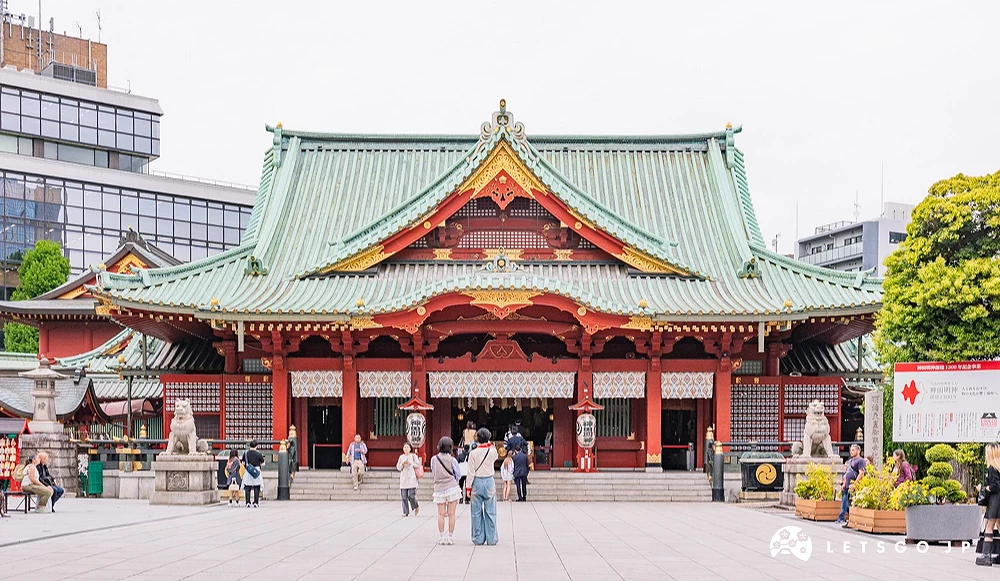
Kanda Shrine (Kanda Myojin) is a shrine with more than 1,000 years of history, located near Akihabara Electric Town, Tokyo’s famous hub of subculture. It is worshipped for blessings in relationships and business prosperity, and is also widely known as an “information security shrine.” This guide takes an in-depth look at the highlights of Kanda Shrine, access and worship information, its colorful amulets and other sacred items, eye-catching festivals, and nearby attractions that are easy to combine with your visit.
Introduction to Kanda Shrine
Kanda Shrine is about a 7-minute walk from Akihabara Electric Town and serves as the guardian shrine for 108 neighborhood associations across Kanda, Nihonbashi, Akihabara, Otemachi, Marunouchi, and surrounding areas. The shrine was founded around Otemachi in 730 AD and was later relocated in 1616 during the Edo period to a position protecting the northeast approach to Edo Castle. It came to be revered as the “General Guardian of Edo.” This historic shrine will celebrate the 1,300th anniversary of its founding in 2030.
Kanda Shrine Is Commonly Known as “Kanda Myojin”

“Kanda Shrine” and “Kanda Myojin” refer to the same shrine. Its official name is Kanda Shrine, while “Kanda Myojin” has been its popular name since the Edo period. Although the official shrine name was changed to Kanda Shrine during the Meiji era, worshippers still affectionately call it “Myojin-sama.” The official website, goshuin, and station signs also frequently use both names, so there is no need to worry that you have gone to the wrong place.
The Three Enshrined Deities of Kanda Shrine and Their Blessings

Kanda Shrine enshrines three principal deities. The first is Onamuchi-no-Mikoto, the same deity as Okuninushi-no-Mikoto of Izumo Taisha, also known as Daikokuten, who is associated with matchmaking and marital harmony. The second is Sukunahikona-no-Mikoto, also known as Ebisu, who is worshipped for business prosperity, good fortune, and success. The third is Taira no Masakado-no-Mikoto, who is believed to ward off misfortune and calamity. Because Akihabara Electric Town also lies within the shrine’s guardian area, Kanda Shrine is also regarded as a protector of IT and information security.
Kanda Shrine Worship Information

Except for formal prayers conducted inside the worship hall by shrine priests, the grounds of Kanda Shrine are open 24 hours a day and can be visited free of charge. However, the EDOCCO Cultural Exchange Center, where amulets and goshuin are issued, has limited opening hours. If you want to obtain an amulet or goshuin, be sure to visit during those hours. A standard visit takes about 30 minutes, while around 1 hour is recommended if you want to take more photos and visit the museum. More than 300,000 people visit during the New Year period, so if you prefer to avoid crowds, it is best to avoid January 1–3.
【Paid Facilities and Services】
The grounds of Kanda Shrine are open 24 hours for general worship. The museum and formal prayers conducted by shrine priests require a fee. Although formal prayer applications are accepted only during set hours, advance reservations are not required; you can apply on the day at the EDOCCO Cultural Exchange Center.
| Fee (Hatsuhoryo) | |
|---|---|
| Museum | Adults: 500 yen Students: 300 yen Free for junior high school students and younger |
| Formal Prayer in the Worship Hall (Prayer Ceremony) | From 10,000 yen |
Opening Hours for Paid Facilities
EDOCCO Cultural Exchange Center: 9:00–18:00
Museum: 9:00–16:00 Last admission 15:45
Kanda Shrine Access Guide
Kanda Shrine is within walking distance of JR Ochanomizu Station and Akihabara Station, with several subway stations also nearby, making it easy to visit after exploring Akihabara. From Tokyo Station, take a JR Chuo Line Rapid train to Ochanomizu Station in just about 4 minutes, then walk about 5 minutes to the shrine. If you come from the Akihabara side, you may pass a steep stone staircase called “Otoko-zaka.” If you prefer not to climb stairs or have limited mobility, you can instead take the gentler slope along the main approach.
【Nearest Stations to Kanda Shrine】
| Nearest Station | Exit | Walking Time |
|---|---|---|
| JR Chuo Line JR Sobu Line Ochanomizu Station | Hijiribashi Exit | About 5 minutes |
| JR Yamanote Line JR Keihin-Tohoku Line Akihabara Station | Electric Town Exit | About 7 minutes |
| Tokyo Metro Ginza Line Suehirocho Station | Exits 3 and 4 | About 5 minutes |
Must-See Highlights at Kanda Shrine
Zuishinmon Gate and the Main Shrine Buildings

Rebuilt in 1975, the Zuishinmon Gate is a two-story structure made entirely of Japanese cypress. On the upper story, a gold-leaf horse-tethering carving tells the story of Taira no Masakado, who is enshrined here. The main shrine buildings were rebuilt in 1934 after the Great Kanto Earthquake using a then-innovative steel-frame reinforced-concrete structure and finished entirely in vermilion lacquer. Their excellent fire-resistant construction allowed the shrine to survive the 1945 Tokyo air raids with almost no damage. In 2003, the buildings were officially designated as a Registered Tangible Cultural Property of Japan.
Statues of Daikokuten and Ebisu

The Daikokuten statue beside the approach is 6.6 meters tall and weighs about 30 tons, making it the largest stone statue of Daikokuten in Japan. On the other side, the Ebisu statue has a distinctive design showing him crossing the sea on waves surrounded by dolphins and sea bream, very different from the usual image of Ebisu holding a fishing rod. Both statues are among the most popular photo spots on the shrine grounds.
Sacred Horse and Shishi-yama

The shrine keeps a sacred horse named Akari, who usually stays in the stable and is taken out for two walks each day. She is one of the shrine’s most beloved mascots. From July to September, Akari leaves the shrine to escape the summer heat. Beside the main hall is also a “Shishi-yama” lion mound, modeled after the famous scene of a lion leaping from a cliff in the Noh play “Shakkyo.” It is one of the renowned “Three Lions of Bando.”
Festivals at Kanda Shrine
Noryo Festival (Early August Every Year)

Kanda Shrine holds a three-day Noryo Festival in early August each year. A bon-odori dance platform is set up on the grounds, and the “Gourmet Food☆Beer & Sake Festival” is held at the same time with a wide variety of food stalls. Admission is free and anyone can join, making it one of the easiest and liveliest ways to experience a local festival. One evening also features a special “Anime Song Bon Odori,” where participants dance around the platform to anime songs, creating a uniquely Akihabara-style scene. The exact dates vary each year, so check the official website for the latest announcement.
Kanda Myojin Noryo Festival (2026)
Dates: August 7–9
Anime Song Bon Odori: August 7 16:30–20:30
Kanda Matsuri

Kanda Matsuri is counted alongside Kyoto’s Gion Matsuri and Osaka’s Tenjin Matsuri as one of the “Three Great Festivals of Japan.” During the Edo period, it was also known as the “Tenka Matsuri,” or Festival of the Shogun’s Realm. The annual grand festival is held every May 15. Even-numbered years are quieter “Kage Matsuri” years, while odd-numbered years feature the grand “Hon Matsuri,” including the Shinkosai procession, Tsukematsuri, and mikoshi shrine-entry ceremonies. As Tokyo developed, long processions became increasingly difficult to hold in the city center. The Shinkosai procession once lasted three days, was later shortened to two, and is now held in a single day, while the overall Hon Matsuri period lasts about one week.
The next Hon Matsuri is expected to take place in May 2027. If you cannot attend in person, you can also watch the festival live through the shrine’s official online stream.
Kanda Matsuri
Annual Grand Festival: May 15 every year
Next Hon Matsuri (Expected): May 2027
Kanda Shrine Amulets and Goshuin
Kanda Shrine offers more than 50 types of beautifully designed sacred items, including amulets and goshuin. They are available at the amulet counter on the first floor of the EDOCCO Cultural Exchange Center from 9:00 to 18:00.

Must-Buy Amulets and Prices
The shrine’s officially recognized signature amulet is the “Kachimamori” Victory Amulet, said to have protected Tokugawa Ieyasu and helped bring victory at the Battle of Sekigahara. Another especially popular item is the “IT Information Security Amulet,” unique to the guardian shrine of Akihabara. Its circuit-board-inspired design even comes with a special sticker that can be placed on a laptop. Other options include wealth amulets, crystal magatama amulets, rabbit-themed wish amulets, and beautiful lace amulets. Prayer ema plaques are available in three designs—for wishes, matchmaking, and the sacred horse—at 500 yen each.
| Amulet | Hatsuhoryo | Features |
|---|---|---|
| Kachimamori Victory Amulet | 500 yen | Said to have protected Tokugawa Ieyasu and brought victory at Sekigahara One of the earliest shrines in Japan to issue victory amulets |
| IT Information Security Amulet | 1,000 yen | Includes a sticker that can be placed on a laptop |
| Lace Amulet | 2,000 yen | Kanda Myojin’s first lace-material amulet Wisteria flower and rabbit design |
| Umaku Iku Omamori | 1,000 yen | Features the sacred horse Akari Prays for everything to go smoothly |
| Beauty Amulet | 1,000 yen | Prays for lasting beauty Popular with women |
Goshuin and Goshuincho
The goshuin at Kanda Shrine costs 500 yen as a hatsuhoryo offering. At present, only pre-written paper versions are available, and handwritten goshuin are not offered on the spot. The shrine’s original goshuincho stamp books are available in navy blue and red. During festivals such as Kanda Matsuri and the Noryo Festival, or during collaborations with anime titles, the shrine often releases eye-catching limited-edition designs. Availability periods and quantities are limited, so interested travelers should check the official website for announcements.
Attractions Around Kanda Shrine
Akihabara

Walk downhill from Kanda Shrine for about 7 minutes and you will reach Akihabara Electric Town, often called an “otaku paradise.” Here you can browse anime merchandise, video games, idol goods, capsule-toy stores, and more. Kanda Shrine itself has served as the inspiration for settings in several anime titles and has been selected as one of Japan’s “88 Anime Pilgrimage Sites.” If you love anime and otaku culture, combining Kanda Shrine with Akihabara Electric Town makes an ideal itinerary.
Yushima Seido

Yushima Seido, located across Hongo-dori Avenue from Kanda Shrine, is an excellent nearby attraction to combine with your visit. Established by the Edo shogunate as a center for Confucian studies, it enshrines Confucius and is regarded as one of the birthplaces of modern school education in Japan. Well-known institutions such as the University of Tsukuba and Ochanomizu University have deep historical connections with this “Tokyo Confucian Temple.” Its all-black buildings form a striking contrast with the vermilion Kanda Myojin. The quiet grounds are free to enter. Students may also wish to pray here for academic success and good exam results.
Address: 1-4-25 Yushima, Bunkyo-ku, Tokyo
Opening Hours: 9:30–17:00 ※Until 16:00 in winter
Admission: Free
Access: About a 2-minute walk from Kanda Shrine
Ochanomizu

Walk about 5 minutes west from Kanda Shrine to reach the Ochanomizu area. This neighborhood is home to one of Japan’s best-known musical instrument streets, lined with guitar shops and specialty instrument stores. Along the way, you can also stop at Amanoya, a traditional Japanese sweets shop beside the shrine’s torii gate. Founded in the Edo period, it is famous for amazake made with its own rice koji and is a perfect place to take a break. The Byzantine-style Orthodox cathedral known as Nikolai-do is also within walking distance, giving you a rare chance to visit a Shinto shrine, Confucian temple, and Christian church in the same area.
Kanda Shrine is not only a place to pray for good relationships, business prosperity, and IT information security. From festivals to sacred items, it frequently incorporates anime and other forms of subculture, allowing traditional faith to be passed down in step with contemporary trends. On your next trip to Tokyo, consider setting aside half a day to visit this vibrant center of traditional worship and experience the unique charm created by the meeting of old and new culture.
Kanda Shrine Visitor Q&A
1. Which Kanda Shrine amulet is recommended?
Kanda Shrine offers more than 50 types of sacred items at the amulet counter on the first floor of the EDOCCO Cultural Exchange Center. The officially recognized signature amulet is the “Kachimamori” Victory Amulet (500 yen), said to have protected Tokugawa Ieyasu during his victory at Sekigahara. The “IT Information Security Amulet” (1,000 yen, including a laptop sticker) is especially suitable for office workers and IT professionals. The beautiful “Lace Amulet” (2,000 yen), decorated with wisteria flowers and rabbits, is the most photogenic choice.
2. Is the goshuin at Kanda Shrine handwritten on site?No. Kanda Shrine currently offers only pre-written paper goshuin, with a hatsuhoryo offering of 500 yen.
3. Is Kanda Shrine an anime pilgrimage site?
Yes. Kanda Shrine has inspired settings in several anime works, has been selected as one of Japan’s “88 Anime Pilgrimage Sites,” and frequently collaborates with anime titles. During the Noryo Festival each August, there is even a special Anime Song Bon Odori session, making the shrine a true pilgrimage spot for anime fans.
4. When is the next Kanda Matsuri mikoshi procession?
The grand Shinkosai procession and mikoshi shrine-entry ceremonies are held only during the Kanda Matsuri “Hon Matsuri” in odd-numbered years. The year 2026 is a quieter Kage Matsuri year, so these special ceremonies will not take place. The next Hon Matsuri is expected in May 2027.