
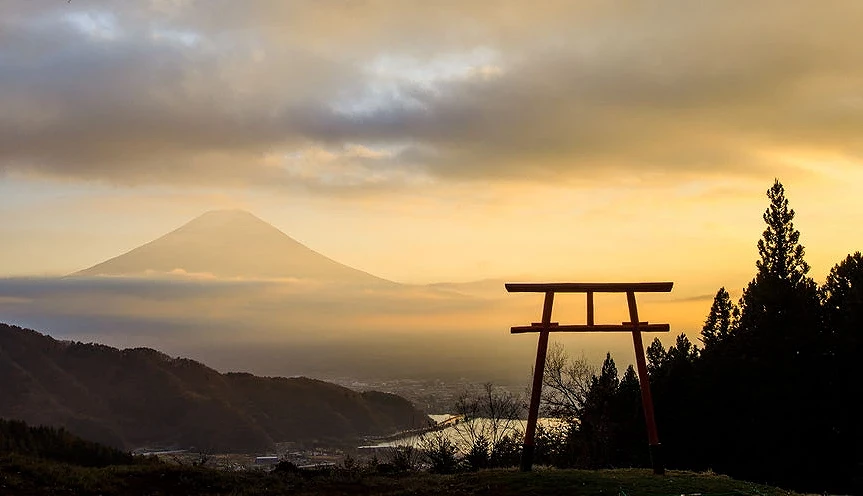
Located in Fujikawaguchiko, Yamanashi Prefecture, Kawaguchi Asama Shrine is a must-visit landmark for first-time visitors to Mount Fuji, alongside the beautiful lake and mountain scenery. The shrine has a long history, while the “Tenku no Torii” Mount Fuji Worship Site on the mountain behind it has become a hugely popular scenic photo spot in recent years. This guide covers transportation to Kawaguchi Asama Shrine, the thousand-year-old Seven Sacred Cedars, goshuin and unique omamori, photography rules at the Tenku no Torii, and seasonal scenery. It also includes a recommended day-trip route featuring Oishi Park, Arakura Fuji Sengen Shrine, and other nearby attractions—essential reading before planning your Lake Kawaguchi trip.

Kawaguchi Asama Shrine, located in Fujikawaguchiko, Yamanashi Prefecture, was founded in Jogan 7 of the Heian period (865 AD). It was originally established to pray for the pacification of Mount Fuji's violent eruptions by enshrining the Asama deity. The shrine's principal deity is Konohanasakuya-hime-no-Mikoto. As well as being an important center of Mount Fuji worship, the shrine is known for prayers for good relationships, safe childbirth, and protection from misfortune. Today, Kawaguchi Asama Shrine is officially registered as one of the component sites of the UNESCO World Heritage property “Fujisan, Sacred Place and Source of Artistic Inspiration,” making it a sacred site of exceptional historical and cultural value.
Getting to Kawaguchi Asama Shrine
Getting to Kawaguchi Asama Shrine is relatively easy. From Kawaguchiko Station, the most common option is a local bus, with a one-way fare of about ¥330–¥350 to a stop near the shrine. If you are driving, free parking is available around the shrine, followed by only a short walk to the main shrine. For travelers who do not want to drive and prefer to avoid waiting for public transportation, taking a taxi directly from Kawaguchiko Station is also a convenient time-saving option.

How to Get to Asama Shrine
| Transportation | Route | Travel Time |
|---|---|---|
| Local Bus | Kawaguchiko Station → Kawaguchi-kyokumae | About 10 minutes |
| Taxi | From Kawaguchiko Station | About 7 minutes |
| Driving | Take the Chuo Expressway and exit at Kawaguchiko IC | About 15 minutes |
Free Parking Near Kawaguchi Asama Shrine
Kawaguchi Asama Shrine Parking Lot (Asama Plaza): Kawaguchi, Fujikawaguchiko, Minamitsuru District, Yamanashi Prefecture (Mapcode: 161 393 184*28)
Tenku no Torii Parking Lot: Kawaguchi, Fujikawaguchiko, Minamitsuru District, Yamanashi Prefecture (Mapcode: 161 393 619*45)
Haha-no-Shirataki Waterfall Parking Lot: Kawaguchi, Fujikawaguchiko, Minamitsuru District, Yamanashi Prefecture (Mapcode: 161 393 689*72)
Getting to the Tenku no Torii Worship Site
| Starting Point | Transportation | Travel Time | |
|---|---|---|---|
| Main Shrine | On Foot | About 30–40 minutes | |
| Driving | About 6 minutes | ||
| Taxi | |||
| Kawaguchiko Station | Driving | About 12 minutes | |
| Taxi | |||
Important Notes for Visiting the Worship Site
If you walk uphill, the entire route is paved, so ordinary casual shoes are sufficient and professional hiking gear is not necessary.
If you drive, note that the mountain road is extremely narrow, often only wide enough for one vehicle, making it difficult for cars to pass each other. The road can freeze in winter, so snow tires are essential.
The parking lot at the mountain worship site is very small, with only about five spaces, and fills easily on holidays. If it is full, park at the main shrine parking lot at the foot of the mountain and walk uphill.
From Tokyo, first take a train or highway bus to Kawaguchiko Station, which takes about 2 hours. See the related guide below for detailed transportation information.
Highlights Inside Kawaguchi Asama Shrine
Thousand-Year-Old Seven Sacred Cedars
In addition to the historic shrine buildings, the most impressive sight within Kawaguchi Asama Shrine at the foot of the mountain is a group of seven enormous cedar trees rising high into the sky, collectively known as the “Seven Sacred Cedars.” These sacred trees surround the worship hall, and each is estimated to be around 1,200 years old. They have witnessed more than a millennium of history associated with Mount Fuji and the shrine and are designated Natural Monuments of Yamanashi Prefecture. Walking among these ancient trees offers a profound sense of nature's majesty and tranquility and is one of the highlights you should not miss when visiting.


Goshuin and Omamori at Kawaguchi Asama Shrine
Many visitors to Kawaguchi Asama Shrine collect its distinctive goshuin. Both the main Kawaguchi Asama Shrine and the Mount Fuji Worship Site (Tenku no Torii) on the mountain behind it offer their own exclusive goshuin. The main shrine's goshuin has a dignified design, while the worship site's version features the classic combination of a torii gate and Mount Fuji, making it a memorable keepsake.

The shrine also sells a variety of distinctive omamori, including charms for safe childbirth, matchmaking, and limited cherry-blossom designs. One important point is that all omamori are sold only at the main Kawaguchi Asama Shrine at the foot of the mountain; the worship site does not sell omamori. It is recommended to visit the main shrine first to worship, buy omamori, and receive your goshuin before heading uphill to the worship site.
Goshuin and Omamori Sales Hours
Kawaguchi Asama Shrine Main Shrine: 09:00–16:00 (omamori and main-shrine goshuin available)
Mount Fuji Worship Site: 09:00–16:00 (only the worship site's exclusive goshuin is available; actual hours are subject to official announcements)
Photo Spots Behind Kawaguchi Asama Shrine
Tenku no Torii Worship Site

The “Tenku no Torii,” which has become extremely popular on social media in recent years, is actually a nickname for the Mount Fuji Worship Site on the mountain behind Kawaguchi Asama Shrine. Located halfway up the mountain, the site has an unobstructed view directly toward magnificent Mount Fuji. On a clear day, the vivid vermilion torii gate and Mount Fuji in the background create a breathtaking composition that attracts photographers from around the world. Note that the Mount Fuji Worship Site and the main Kawaguchi Asama Shrine at the foot of the mountain are managed separately, and an additional cooperation fee is required to enter the worship-site grounds.
| Visitor Type | Admission Fee |
|---|---|
| Adults | ¥200 |
| Children (Ages 6 to under 18) | ¥100 |
Address: 1119-2 Kawaguchi, Fujikawaguchiko, Minamitsuru District, Yamanashi Prefecture
Opening Hours: Open year-round / Daily 09:00–16:00 (hours may be adjusted according to sunset; check official announcements before departure)
Seasonal Scenery at the Tenku no Torii Worship Site
| Season | Scenic Highlights |
|---|---|
| Spring (March–May) | Cherry trees bloom along the route to the worship site You may be able to photograph the cherry blossoms in the same frame |
| Summer (June–August) | A sea of clouds may occasionally appear You may capture a dreamlike scene of the torii gate appearing above the clouds |
| Autumn (September–November) | Autumn foliage and the torii gate appear together The composition is especially rich and vibrant in color |
| Winter (December–February) | Snow-covered Mount Fuji contrasts dramatically with the vermilion torii gate Widely considered the most beautiful season for photography |
Photography Rules at the Worship Site (Must Read)
If you use professional equipment such as a DSLR camera, you must register as a member and pay an annual fee (smartphone photography is free).
Wedding photography and shoots by professional photographers, including friends or relatives acting as photographers, require advance application and an additional location-use fee.
Commercial, advertising, or business-purpose photography requires advance application; fees are quoted separately.
During busy periods, staff may time each group. Shooting time is limited, so do not monopolize the location.
For safety and smooth visitor flow, tripods are prohibited except in certain designated areas.
Do not cross rope barriers or enter planted areas.
For safety reasons, drone and aerial photography are completely prohibited.
Attractions Near Kawaguchi Asama Shrine
After visiting the main Kawaguchi Asama Shrine and the mountain worship site, consider adding the following classic Lake Kawaguchi attractions to make your Mount Fuji day trip even more rewarding. Here is a recommended one-day driving/bus route:
| 1Day | Kawaguchi Asama Shrine (worship and buy omamori) → Mount Fuji Worship Site “Tenku no Torii” → Arakura Fuji Sengen Shrine (view the five-story pagoda and Mount Fuji) → Oishi Park (flower fields, inverted Mount Fuji reflections, and ice cream) → Return to Kawaguchiko Station in the evening |
|---|
Oishi Park

Oishi Park, located on the northern shore of Lake Kawaguchi, is an extremely popular flower-viewing spot for enjoying Mount Fuji and the famous “inverted Mount Fuji” reflection. The scenery changes throughout the year: dreamy purple lavender in summer, bright red kochia in autumn, and excellent conditions for photographing Mount Fuji reflected on the lake in winter. After strolling along the lakeside path and taking plenty of photos, you can stop at a nearby shop for Kyoho grape soft-serve ice cream and enjoy it while admiring the view.
Arakura Fuji Sengen Shrine

Arakura Fuji Sengen Shrine in Fujiyoshida is internationally famous for its classic three-in-one composition of “Mount Fuji + five-story pagoda + cherry blossoms.” After reaching the shrine, you need to climb 398 stone steps to the observation deck at the top. The landscape here is very different from the horizontal composition of the Tenku no Torii, making the two locations ideal to visit on the same day for travelers who enjoy Mount Fuji photography.
Around Kawaguchiko Station

For more must-visit attractions, recommended accommodation, and a food map around Lake Kawaguchi, see the complete Lake Kawaguchi travel guide below.
| Nearby Attractions | Highlights |
|---|---|
| Mt. Fuji Panoramic Ropeway and Tenjoyama Park | Take the ropeway up the mountain for an effortless panoramic view of Lake Kawaguchi and magnificent Mount Fuji from above |
| Kawaguchiko Music Forest Museum | A European fairy-tale-style garden with elegant music-box exhibits, ideal as a rainy-day option or for a relaxing afternoon stroll |
Kawaguchi Asama Shrine and the Tenku no Torii in Yamanashi Prefecture are must-visit photo spots for spectacular Mount Fuji views. Whether you visit for spring cherry blossoms, a summer sea of clouds, autumn foliage, or the dramatic winter contrast between snow-covered Mount Fuji and the vermilion torii gate, there is beautiful scenery here throughout the year. Save this guide for your next independent trip from Tokyo to Lake Kawaguchi.
Kawaguchi Asama Shrine FAQ
1. Are the Main Kawaguchi Asama Shrine and the Tenku no Torii Worship Site in the Same Place?
No. The main Kawaguchi Asama Shrine is located at the foot of the mountain and is a historic shrine where visitors can worship and purchase omamori and goshuin. The worship site with the “Tenku no Torii” is located halfway up the mountain. It takes about 30–40 minutes to walk uphill from the main shrine, or you can drive or take a taxi directly. It is recommended to include both locations in your itinerary: visit the main shrine first, then head uphill to the worship site for photos.
2. Is It Difficult to Walk Up to the Worship Site? Do You Need Hiking Gear?
No, the route is not particularly difficult. The entire walk from the main shrine to the worship site is on a paved road, so ordinary casual shoes are sufficient and professional hiking gear is not required.
3. Is It Still Worth Visiting If Mount Fuji Is Hidden by Clouds? Can You Check in Advance?
The main appeal of the Tenku no Torii is the composition with Mount Fuji in the background, so if the mountain is hidden by clouds or mist, the photographic effect is greatly reduced. Before setting out, check a live-camera website and visit when Mount Fuji is clearly visible to reduce the chance of making the trip in vain.
4. Where Can You Buy Omamori and Goshuin? Are They Sold at the Worship Site?
Omamori are sold only at the shrine office of the main shrine at the foot of the mountain, while the worship site does not offer omamori (it only has its own exclusive goshuin). It is recommended to worship and make your purchases at the main shrine before heading uphill, so you do not forget or return after the shrine office has closed.
5. What Photography Restrictions Apply? Can You Use a Tripod or Drone?
The worship site has clear photography rules: smartphone photography is free, but using professional equipment such as a DSLR camera requires membership registration and a usage fee. Tripods may be used only in designated areas and are prohibited elsewhere. Drones and aerial photography are completely prohibited. Wedding and commercial photography require an application to the worship site at least one month before the shooting date.