
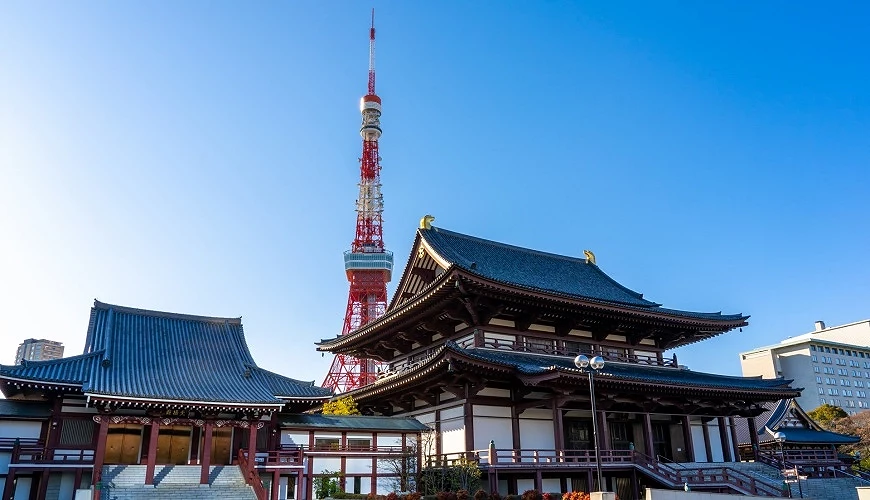
Zojoji Temple, located in Shiba Park in Minato City, Tokyo, is the head temple of the Jodo sect and stands at the foot of Tokyo Tower. Known as a temple of “victory and good fortune” because of its historical connection with Tokugawa Ieyasu’s military success, it also serves as the family temple of the Tokugawa shoguns. With several nearby stations, it is an easy historical attraction to explore in a relatively short time. Here is a complete look at Zojoji’s must-see highlights, distinctive sacred items, seasonal festivals, and essential visitor information.
Zojoji Temple is located in Shiba Park, Minato City, Tokyo, right beside Tokyo Tower, making it one of the rare large historic temples in central Tokyo. Its official name is Sanenzan Kodo-in Zojoji. It is the head temple of the Jodo sect, founded in 1393 by Yuyo Shoso. In 1590, Tokugawa Ieyasu selected it as the family temple of the Tokugawa clan, and it was relocated to its present site in 1598.

During the Edo period, Zojoji ranked first among the eighteen major Jodo seminaries in the Kanto region. At its peak, more than 3,000 monks trained on the temple grounds. According to tradition, the secret Amida Buddha known as the “Black Honzon” helped Tokugawa Ieyasu overcome numerous hardships and ultimately unify the country, earning Zojoji its reputation as the “Temple of Victory and Good Fortune.”

The “Black Honzon” is a statue of Amida Buddha that Tokugawa Ieyasu personally worshipped and carried with him. Tradition holds that its protection helped him survive repeated dangers and win key battles. Since the Edo period, the Black Honzon has therefore been revered as a powerful Buddhist image associated with victory, protection from misfortune, and the fulfillment of wishes. Zojoji’s amulets also center on the Black Honzon and the theme of “victory and good fortune.” The Black Honzon is normally kept hidden from public view and is displayed only on designated days.
Zojoji Temple Visiting Hours, Admission Fees, and Recommended Visit Duration
The grounds of Zojoji Temple are free to enter and open for general worship. Only the Tokugawa Shogun Family Graveyard and the Treasure Gallery require admission fees. Both facilities are closed on Tuesdays, so visitors who wish to enter should avoid Tuesday visits. A combined ticket for the two facilities costs 200 yen less than buying separate tickets. About 1 hour is enough for a walk around the temple grounds, while 1.5 to 2 hours is recommended if you also plan to visit the graveyard and Treasure Gallery.
Zojoji Temple does not have its own parking lot, so visitors are strongly advised to use public transportation. The Main Hall has an elevator, and wheelchairs are available to borrow, making the temple accessible for visitors with limited mobility and elderly travelers.
Admission Fees for Paid Facilities
| Tokugawa Graveyard Admission | Adults: 500 yen (Free for high school students and younger) |
|---|---|
| Treasure Gallery Admission | Adults: 700 yen Junior high and high school students: 300 yen Free for elementary school students and younger |
| Combined Ticket for Both Facilities | 1,000 yen |
Opening Hours of Facilities at Zojoji Temple
Main Hall: 6:00–17:30
Ankokuden Hall (Amulets and Goshuin): 9:00–17:00
Tokugawa Shogun Family Graveyard: 【Weekdays】11:00–15:00 (last admission 14:45) 【Weekends and Holidays】10:00–16:00 (last admission 15:45)
Treasure Gallery: 【Weekdays】11:00–15:00 【Weekends and Holidays】10:00–16:00
Closed: The graveyard and Treasure Gallery are closed every Tuesday (open as usual if Tuesday falls on a public holiday)
How to Get to Zojoji Temple
Zojoji Temple is surrounded by an extensive transportation network. The nearest stations are Onarimon Station and Shibakoen Station on the Toei Mita Line. From Haneda Airport, the easiest route is to take the Tokyo Monorail directly to Hamamatsucho Station and walk from there. From Tokyo Station, the JR Yamanote Line or Keihin-Tohoku Line reaches Hamamatsucho Station in about 4–7 minutes. If you also plan to visit Tokyo Tower on the same day, using Akabanebashi Station on the Toei Oedo Line or Kamiyacho Station on the Tokyo Metro Hibiya Line can make your route more convenient.
【Stations Near Zojoji Temple】
| Station | Line | Walking Time |
|---|---|---|
| Onarimon Station Shibakoen Station | Toei Subway Mita Line | About 3 minutes |
| Daimon Station | Toei Subway Asakusa Line Oedo Line | About 5 minutes |
| Akabanebashi Station | Toei Subway Oedo Line | About 7 minutes |
| Hamamatsucho Station | JR Lines Tokyo Monorail | About 10 minutes |
| Kamiyacho Station | Tokyo Metro Hibiya Line | About 10 minutes |
Must-See Highlights at Zojoji Temple
With several centuries of history and deep ties to the Tokugawa shogunate, Zojoji’s temple buildings and the Tokugawa family graveyard are naturally among its main highlights. Its location beside Tokyo Tower also makes it one of the best places to photograph the tower. A recommended walking route is: Sangedatsumon Gate → Main Hall Plaza, the best spot for photographing Tokyo Tower → Ankokuden Hall → Tokugawa Shogun Family Graveyard → Treasure Gallery.
Tokyo Tower and the Main Hall in One Frame

Tokyo Tower rises diagonally behind Zojoji’s Main Hall, allowing visitors to capture the solemn historic temple and the vivid red modern tower in a single frame from the plaza in front of the Main Hall. This composition, blending modernity and tradition, is one of the rare iconic views of central Tokyo and one of Zojoji’s most popular photo spots. Because of the dramatic height difference between the temple and Tokyo Tower, a vertical composition with a wide-angle lens is recommended. In the evening, when Tokyo Tower lights up, the scene takes on a completely different atmosphere, and you can also continue on to the tower for nighttime city views.
Sangedatsumon Gate

Rebuilt in 1622, Sangedatsumon Gate, also known simply as Sanmon, is one of the largest wooden temple gates in eastern Japan and is designated as an Important Cultural Property of Japan. One of Tokyo’s oldest major temple gates, it entered a large-scale conservation and restoration project in autumn 2025, with completion scheduled for 2032. During the long restoration period, the gate will be fully enclosed by a steel protective structure, so its original imposing appearance cannot be seen. The three Shakyamuni statues formerly housed upstairs were transported directly to a workshop in Kyoto for restoration, while the statues of the Sixteen Arhats and successive high priests have been temporarily relocated to Jiun-kaku, also known as Kaizando, within the temple grounds.
During the construction period, the passage beneath Sangedatsumon Gate may also be temporarily closed, and the plaza in front of the bell tower will be used as a construction area. Therefore, visitors coming to Zojoji before the work is completed in 2032 are advised to focus on the Main Hall and the Tokugawa graveyard.
Main Hall, Ankokuden Hall, and the Thousand Jizo Statues for Children

The Main Hall, rebuilt in 1974, is one of the largest Buddhist temple halls in the Tokyo metropolitan area, with the Treasure Gallery located on its basement level. Ankokuden Hall enshrines the secret “Black Honzon,” believed to bring victory and good fortune, and also houses the counter for receiving amulets and goshuin. The Black Honzon is specially unveiled only at New Year and on the 15th of May and September each year (exact viewing hours depend on the temple’s announcement for each occasion). On those days, a grand “Victory and Good Fortune Black Honzon Prayer Ceremony” is also held at 14:00.
Another must-see photo highlight is the “Thousand Jizo Statues for Children.” Rows of Jizo statues wearing red knitted caps and decorated with colorful pinwheels create a beautiful scene while symbolizing prayers for safe childbirth and the healthy growth of children.
Tokugawa Shogun Family Graveyard

The Tokugawa Shogun Family Graveyard contains the graves of six Tokugawa shoguns: Hidetada, the 2nd shogun; Ienobu, the 6th; Ietsugu, the 7th; Ieshige, the 9th; Ieyoshi, the 12th; and Iemochi, the 14th. It also contains the graves of five official wives, five concubines, and children of the shoguns, for a total of 38 members of the Tokugawa family. Among them is Princess Kazunomiya, also known as Seikan-in, the official wife of the 14th shogun Iemochi. She is buried beside him, and their memorial pagodas remain well preserved.
Before World War II, the magnificent Tokugawa family mausoleums stood on both the north and south sides of the Main Hall. Most were unfortunately destroyed during the war, and the remains were reinterred in the present shogunal graveyard in 1958. On weekends and national holidays, volunteer tourism guides from Minato City are often available to provide free guided explanations.
Treasure Gallery

Zojoji’s Treasure Gallery is located on the basement level of the Main Hall. Its centerpiece is the impressive “Taitoku-in Mausoleum Model.” Measuring 4 meters long and 6 meters wide, this enormous model meticulously recreates the magnificent mausoleum built in 1632 by the 3rd shogun, Tokugawa Iemitsu, for his father Hidetada. It is said to have served as a prototype for the UNESCO World Heritage Site Nikko Toshogu Shrine. The original mausoleum was designated a National Treasure in 1930 but was later destroyed by wartime fire.
The model displayed in the gallery was created by the Tokyo School of Fine Arts, now Tokyo University of the Arts. After being exhibited at the Japan-British Exhibition, it remained on display at Kew Gardens in London and was later stored for many years in the British Royal Collection before finally returning to Japan in 2014. The roof of the model’s main sanctuary has intentionally been removed so visitors can directly admire the astonishingly colorful interior.
Seasonal Events and New Year’s Eve Worship at Zojoji Temple
Zojoji Temple offers different scenery, events, and religious ceremonies throughout the year. Among them, the spring cherry blossom season and New Year worship are especially popular with travelers from Taiwan. Below is a detailed introduction to the temple’s seasonal highlights.
Spring: Cherry Blossoms and the Flower Festival

Every spring, when cherry blossoms bloom across Zojoji and neighboring Shiba Park, visitors can enjoy the spectacular combination of “cherry blossoms, Tokyo Tower, and an ancient temple” in a single view. It is one of central Tokyo’s most popular cherry blossom destinations. The best viewing period is usually from late March to early April. Each year from April 2 to 7, the temple holds the Gyoki Grand Memorial Service honoring Honen, founder of the Jodo sect, and a regional products fair from the greater Kanto area is also held on the grounds. This is followed by the Flower Festival, or Buddha’s Birthday Ceremony, at 11:00 on April 8 in front of the Main Hall, where complimentary sweet tea is served.
In addition to historic temples such as Zojoji, Tokyo offers many beautiful cherry blossom spots in spring where visitors can escape the bustle of the city. Parks and riverbanks alike offer spectacular views of cherry trees in full bloom. If you want to discover more photogenic cherry blossom locations around Tokyo, check out the guide below!
Summer: Tanabata Festival and Jizo Bon Odori

Held every year in early July, the Zojoji Tanabata Festival is one of the temple’s signature summer events. In recent years, the romantic “Washi Candle Night” has also been held at the same time, filling the temple grounds after dark with Japanese paper lanterns and candlelight to create a mysterious and solemn atmosphere. In late July, the lively Jizo Bon Odori Festival offers visitors a chance to experience a traditional summer festival in central Tokyo. July is also the busiest month for Buddhist ceremonies at Zojoji, with events such as the Urabon-e and Grand Segaki Memorial Service held in succession, making the temple livelier than usual.
Zojoji Tanabata Festival

The Zojoji Tanabata Festival is held every year on July 7 (July 7 in 2026). The “Washi Candle Night” is held on the evenings of July 6 and July 7. Travelers should check the latest announcement on the official website before visiting.
Winter: Joya-no-Kane Bell Ringing and New Year’s Eve Worship
Zojoji is one of Tokyo’s traditional New Year’s Eve destinations. The temple remains open overnight for worship on New Year’s Eve, and at midnight the solemn Joya-no-Kane bell is rung to symbolize the cleansing of worldly desires accumulated over the past year. The first Buddhist service of the new year, the Shusho-e, is then held in the Main Hall. Against the backdrop of Tokyo Tower on a winter night, the ancient temple takes on a calm atmosphere unlike its usual daytime character, attracting many visitors seeking a peaceful New Year experience.
Opening hours during the New Year period differ from regular hours. See the table below:
| Period | Main Hall Worship | Ankokuden Hall Temple Amulet Counter (Amulets, etc.) |
|---|---|---|
| December 31 | Open all day | Open all day |
| January 1 | Until 17:30 | Until 18:00 |
| January 2 –3 | 6:00~17:30 | 8:00~17:00 |
| From January 4 onward | 6:00~17:30 | 9:00~17:00 |
Japan follows the Gregorian calendar, so New Year’s Eve and New Year’s Day are among the country’s most important annual celebrations. Various events are held throughout Japan to welcome the new year. In addition to hatsumode visits to shrines and temples, there are many other distinctive New Year’s Eve events worth experiencing.
Zojoji Temple Amulets and Goshuin
The Black Honzon, which Tokugawa Ieyasu devoutly worshipped during his lifetime, was believed to have protected him from danger and helped him win numerous battles. For this reason, Zojoji’s amulets strongly emphasize the theme of “victory and good fortune.” To receive amulets or goshuin at Zojoji, visit the distribution counter inside Ankokuden Hall.
Victory and Good Fortune Amulet

The extremely popular “Victory and Good Fortune Amulet” is Zojoji’s classic amulet and is available in several colors and styles, including black, white, red, and purple. The hatsuhoryo offering is 800 yen. The elegant “Victory and Good Fortune Card-Type Amulet (Gold)” costs 1,500 yen, with the words “Black Honzon” engraved on the front and an image of Zojoji’s Main Hall on the back. It is sized to fit neatly inside a wallet so you can carry good fortune with you. Other prayer amulets are also available for health, academic success, good relationships, safe childbirth, and more.
Goshuin and Goshuincho

Zojoji’s official original goshuincho costs 3,000 yen, including one goshuin page, with another version available for 2,000 yen. Its black cover is decorated in gold foil with images of the Main Hall and Tokyo Tower, giving it a refined appearance. The first page also includes a Black Honzon goshuin. Amulets and ofuda received at Zojoji can later be returned to Ankokuden Hall.
Amulets, Goshuin, and Goshuincho
Location: Ankokuden Hall
Hours: 9:00–17:00
Attractions Around Zojoji Temple
Tokyo Tower and Shiba Park

Zojoji Temple stands right beside Tokyo Tower and can be reached in about 6 minutes on foot. Visitors can go up to the observation deck for sweeping views over Tokyo’s urban skyline, or photograph the tower dramatically from below. Combining Zojoji and Tokyo Tower into a half-day itinerary is a classic Tokyo sightseeing plan. Nearby Shiba Park is one of Japan’s oldest public parks and is not only a great green space for photographing Tokyo Tower but also an excellent place for picnics and leisurely walks.
Tokyo Tower is one of Japan’s best-known landmarks and cultural symbols, so naturally it is worth visiting when you are in Tokyo. A complete Tokyo Tower guide can help first-time visitors enjoy the experience to the fullest.
Azabudai Hills

Azabudai Hills is one of Tokyo’s most talked-about new landmarks in recent years and can be reached from Zojoji either by public transportation or a pleasant walk. It offers excellent observation facilities with another impressive perspective of Tokyo Tower, the highly popular teamLab digital art venue, and a wide selection of stylish shopping and dining brands. It is an ideal place to visit after finishing your worship and sightseeing at Zojoji.
Zojoji Temple, which bears witness to the history of the Tokugawa shoguns, is not only one of the rare large historic temples in central Tokyo but also an outstanding photography destination where classical Buddhist architecture and modern Tokyo Tower can be captured together. On your next trip to Tokyo, consider setting aside time to visit Zojoji, experience the power of faith spanning the centuries, and pray for your own victory and good fortune.
Zojoji Temple Visitor Q&A
1. When are the Tokugawa Graveyard and Treasure Gallery at Zojoji closed?
Both the Tokugawa Shogun Family Graveyard and the Treasure Gallery are closed on Tuesdays. However, if Tuesday falls on a Japanese national holiday, they remain open as usual. Opening hours differ slightly between weekdays and weekends/holidays: 11:00–15:00 on weekdays and 10:00–16:00 on weekends and holidays.
2. Can I still see Sangedatsumon Gate at Zojoji now?
Sangedatsumon Gate entered a major conservation and restoration project in autumn 2025, with completion expected in 2032. During this long construction period, the gate will be completely covered by a steel protective structure, so its original magnificent appearance cannot be seen. Access beneath the gate may also be restricted at times during construction.
3. Where is the best angle to photograph Zojoji and Tokyo Tower together?
The best place to photograph Zojoji and Tokyo Tower in the same frame is the plaza in front of the Main Hall. Use a vertical composition with a wide-angle lens to capture both the historic temple and the red Tokyo Tower. After the tower lights up in the evening, the scene takes on a completely different romantic atmosphere.
4. Can I spend New Year’s Eve at Zojoji? How late is it open on December 31?
Yes! Zojoji is one of Tokyo’s best-known New Year’s Eve and hatsumode destinations. In addition to ringing the Joya-no-Kane bell at midnight, the temple remains open overnight from December 31 into New Year’s Day. On January 1, the Main Hall is open until 17:30 and Ankokuden Hall until 18:00.
5. Where can I receive amulets and goshuin at Zojoji?
Zojoji’s amulets and goshuin are all available at Ankokuden Hall, which accepts visitors from 9:00 to 17:00.