
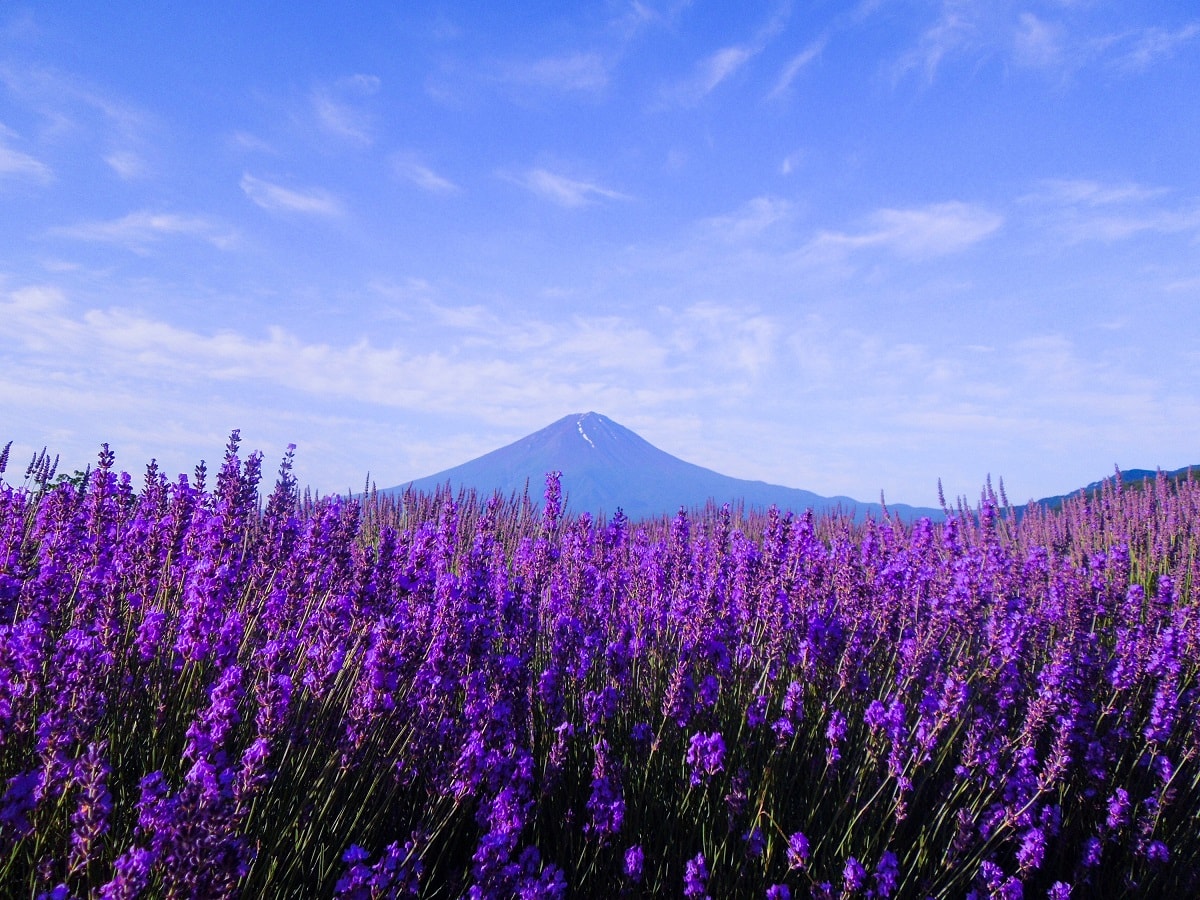
If you want to see Mount Fuji at Lake Kawaguchi, Oishi Park is highly recommended. Located on the lakeshore, the park offers free admission and unobstructed views of Mount Fuji. Different flowers bloom throughout the year, with purple lavender fields creating especially beautiful scenery in summer and round kochia bushes adding charm in autumn. Do not miss Oishi Park during a Lake Kawaguchi day trip. This guide covers transportation and seasonal blooming periods so you can photograph the flowers with Mount Fuji, and you can also combine the visit with a ropeway ride at Mt. Fuji Panoramic Ropeway.
How to Get to Oishi Park

What is the easiest and most affordable way to reach Kawaguchiko Station for a Mount Fuji day trip from Tokyo? My preferred option is the Fuji Excursion limited express, which runs directly from Shinjuku to Kawaguchiko and offers the shortest travel time. The drawback is that services and seats are limited, so tickets can be difficult to obtain. I finally managed to book a ticket through Klook and am looking forward to the trip. Travelers prioritizing lower costs can take a bus, while renting a car provides greater flexibility.
Transportation Options from Tokyo to Lake Kawaguchi
| Transportation Option | Overview | Travel Time | Fare | Advantages and Disadvantages |
| Fuji Excursion Limited Express | Direct service from Shinjuku, Tokyo, to Kawaguchiko Station | Approximately two hours from Shinjuku to Kawaguchiko Station | Fuji Excursion: ¥4,130 one way or ¥8,260 round trip | The fastest option with no transfers, but only two weekday round trips and three weekend or holiday round trips operate between Tokyo and Kawaguchiko, making seats difficult to obtain during popular periods |
| JR Train | Take the JR Chuo Line to Otsuki Station, then transfer to the Fujikyu Railway for Kawaguchiko Station | Approximately 56 minutes from Otsuki to Kawaguchiko Station | The Fujikyu local train costs ¥1,170. The Fujisan View Express requires an additional ¥400 limited-express fee and ¥200 reserved-seat fee. The JR Tokyo Wide Pass covers ordinary Fujikyu Railway services | Frequent services operate to Kawaguchiko Station, including special trains such as the Thomas Land Train and Fujisan Limited Express |
| Highway Bus | Take a Fujikyu bus from Shinjuku Expressway Bus Terminal | Approximately two hours from Shinjuku to Kawaguchiko Station | Approximately ¥2,000. | The simplest direct option to Kawaguchiko, although traffic congestion may cause delays. |
| Rental Car | The most flexible option, with vehicles available from airports, Tokyo Station, and other locations | Approximately 1 hour and 40 minutes | Daily rental rates from approximately NT$1,900 | The most expensive option, but also the most flexible. |
Recommended Transportation from Tokyo to Lake Kawaguchi: Fuji Excursion Limited Express

For a Mount Fuji day trip from Tokyo to Lake Kawaguchi, my most recommended option is the Fuji Excursion limited express. It is currently the only direct train from central Tokyo to the Mount Fuji area. Passengers can enjoy views of Mount Fuji and Fuji-Q Highland along the route, and the seats are comfortable. The main disadvantage is the limited number of seats, which makes tickets difficult to secure. After repeatedly failing to book through the official website, I finally purchased a Fuji Excursion ticket through Klook. The booking and ticket collection process is explained below.
How to Book the Fuji Excursion Limited Express on Klook
Step 1: Open the Fuji Excursion booking page and select Shinjuku as the departure point, followed by your destination and travel date
Step 2: Select your preferred departure and seat
Step 3: Complete payment
Because the Fuji Excursion is extremely popular, purchasing through Klook does not immediately confirm the reservation. Wait for Klook’s confirmation and book as early as possible.
How to Travel from Kawaguchiko Station to Oishi Park
The easiest way to travel from Kawaguchiko Station to Oishi Park is by the Kawaguchiko Sightseeing Bus. Board at Kawaguchiko Station on the Fujikyu Railway and get off at the Kawaguchiko Natural Living Center stop, directly beside Oishi Park. The journey takes approximately 25 minutes. Purchasing a Fuji Five Lakes Sightseeing Bus Pass is recommended because it provides unlimited rides to Oishi Park and other attractions around Lake Kawaguchi.
Travelers who prefer a slower pace can rent a bicycle near Kawaguchiko Station. Riding across Kawaguchiko Ohashi Bridge to Oishi Park takes approximately one hour, and bicycle rental shops around the station charge about ¥1,500–¥2,000 per day. The scenery along the route is excellent. Renting a car is also recommended for exploring Lake Kawaguchi. The drive from Kawaguchiko Station takes approximately 15 minutes, and free parking is available beside Oishi Park.
Seasonal Flowers at Oishi Park, Lake Kawaguchi

Flower lovers should include Oishi Park in a Lake Kawaguchi day trip. In addition to unobstructed views of Mount Fuji across the lake, the park displays different flowers throughout the year. Summer lavender and autumn kochia are particularly beautiful seasonal highlights.
Are There Cherry Blossoms at Oishi Park?
Oishi Park does not have a large number of cherry trees, so fewer visitors come specifically for cherry blossom viewing. The park is better known for lavender and kochia. However, it is still worth visiting while viewing cherry blossoms around Lake Kawaguchi.
Spring Flowers at Oishi Park: Tulips, Rapeseed Blossoms, and German Irises
Spring flowers at Oishi Park include tulips, daffodils, rapeseed blossoms, phlox, German irises, lupines, and catmint. The yellow rapeseed flowers are especially charming, while fields of blooming tulips can resemble scenery in the Netherlands. In spring, photograph the rapeseed fields with Mount Fuji from the lakeside path.
Summer Flowers at Oishi Park: Lavender Season
Summer is Oishi Park’s busiest season. Purple lavender fields spread across the park, creating an exceptionally romantic scene with Mount Fuji in the distance. The Kawaguchiko Herb Festival is also held during summer, featuring local food and lavender-related products.
Autumn Flowers at Oishi Park: Kochia
To see the park’s charming kochia, visit between August and October. The bushes are fresh green from August through September and turn vivid red in October. Their round shape creates an appealing contrast with the blue sky and Mount Fuji.
Winter Scenery at Oishi Park: Snow-Covered Mount Fuji
Although fewer flowers bloom at Oishi Park during winter, snowy days reveal another kind of beauty, with snow-covered Mount Fuji rising beyond Lake Kawaguchi.
| Season | Flower Varieties | Blooming Period | Highlights |
| 🌷 Spring | Tulips, Daffodils, Rapeseed Blossoms, and Phlox | Late April to Late May | Golden rapeseed fields create beautiful views with Mount Fuji! |
| German Irises, Lupines, and Catmint | Late May to Mid-June | Dreamlike purple irises complement the lakeside scenery! | |
| 💜 Summer | Lavender (Main Seasonal Highlight) | Late June to Mid-July | The purple fields are especially romantic during the Kawaguchiko Herb Festival! |
| 🍁 Autumn | Sage, Cosmos, and Green Kochia | August to September | The lakeside flowers change as the atmosphere gradually becomes more autumnal! |
| Red Kochia | Mid- to Late October | The rounded red bushes create a striking contrast with Mount Fuji! | |
| ❄️ Winter | Camellias and Selected Cold-Resistant Plants | December to February | Although fewer flowers bloom, Mount Fuji in the snow looks exceptionally beautiful! |
Highlights of Lavender Season at Oishi Park
Lavender season at Oishi Park, from late June to mid-July, is the most dreamlike period of the year. The entire park is covered in purple flowers, while a gentle lavender fragrance drifts through the air and creates a romantic atmosphere. This is the ideal time to photograph lavender fields with Mount Fuji. During the Kawaguchiko Herb Festival, stage performances and concerts create a lively atmosphere. Market stalls sell local agricultural products and handicrafts, and the popular lavender soft-serve ice cream should not be missed.
To experience the purple flower fields together with views of Mount Fuji, watch for the 2026 Kawaguchiko Herb Festival.
Recommended Attractions Near Oishi Park
Kawaguchiko Music Forest Museum

It happened to be snowing when I visited the Kawaguchiko Music Forest Museum, so the scenery looked different from the museum most people imagine. Inspired by towns in the European Alps, the museum has a distinctly medieval European atmosphere. It is even more colorful in spring and summer, when numerous flowers make the grounds resemble a fairytale setting. As its name suggests, the museum houses many valuable music boxes and automatic musical instruments, including an instrument originally intended for the luxury liner Titanic. In addition to viewing historic music boxes and mechanical performances, visitors can enjoy views of Mount Fuji and walk along the Lake Kawaguchi shore. Unfortunately, the heavy snow during my visit completely obscured the mountains.
Address: 3077-20 Kawaguchi, Fujikawaguchiko, Minamitsuru District, Yamanashi, Japan
Opening Hours: 10:00 a.m.–6:00 p.m. (Last admission: 5:00 p.m.); after January 16, 2023: 10:00 a.m.–5:00 p.m. (Last admission: 4:00 p.m.)
Transportation: Take the Red Line of the Kawaguchiko Sightseeing Bus to the Kawaguchiko Music Forest Museum stop
Itchiku Kubota Art Museum

The Itchiku Kubota Art Museum is an exceptional museum awarded three Michelin stars. It primarily displays works by Japanese textile-dyeing master Itchiku Kubota, whose rich colors and distinctive creative techniques left a lasting mark on traditional Japanese dyeing. Beyond the artwork, the museum’s design and architecture are also exceptionally beautiful and are said to reflect Kubota’s own vision. The design was inspired by his profound appreciation of nature and the universe. A beautiful teahouse allows visitors to enjoy matcha while admiring the scenery, making the museum highly recommended during a Lake Kawaguchi day trip.
Address: 2255 Kawaguchi, Fujikawaguchiko, Minamitsuru District, Yamanashi 401-0304, Japan
Transportation: Take the Red Line of the Kawaguchiko Sightseeing Bus to the Itchiku Kubota Art Museum stop