
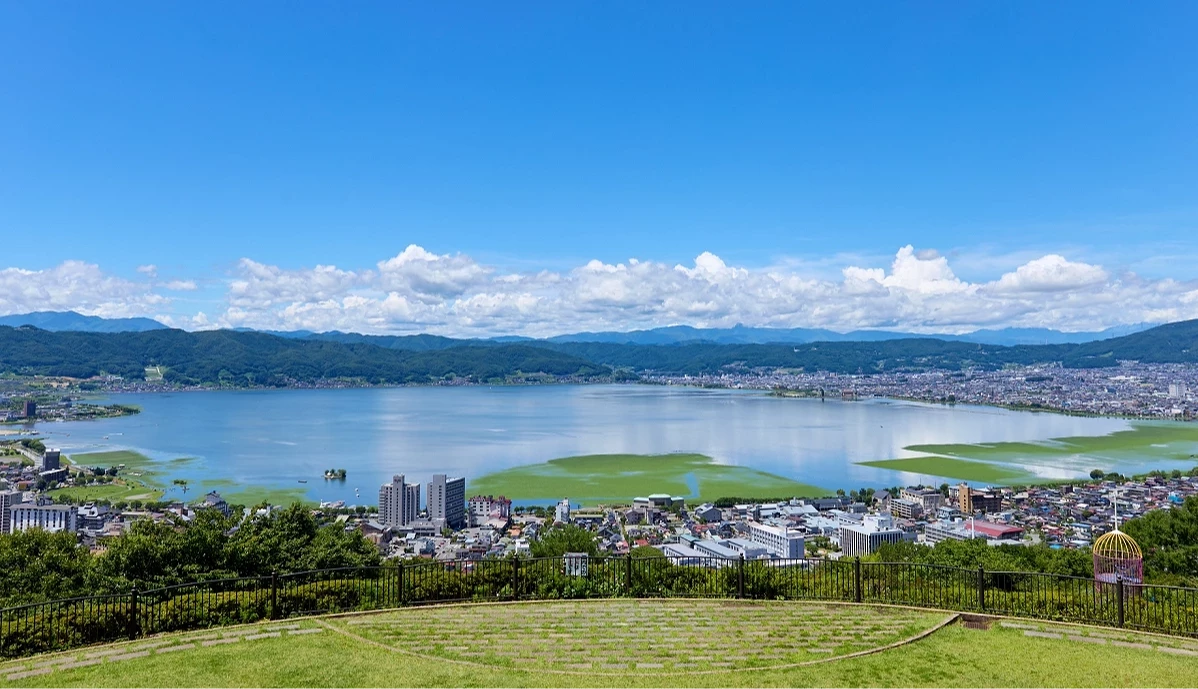
Lake Suwa, the largest lake in Nagano Prefecture, is surrounded by mountains, with Kamisuwa Onsen along its shore and different scenery in every season. In summer, visitors can enjoy fireworks over the lake; in winter, they can discover the legend of Omiwatari. The panoramic lake view from Tateishi Park has also attracted attention because of its resemblance to Lake Itomori in Your Name. Kamisuwa Station can be reached from Shinjuku by limited express in about 2 hours, making Lake Suwa ideal for either a day trip or a hot-spring getaway. This guide introduces the area's attractions, fireworks, transportation, and more.

Lake Suwa is located in central Nagano Prefecture, between Suwa City, Shimosuwa Town, and Okaya City, and is the largest lake in Nagano Prefecture by area. The lake sits at an elevation of about 759 meters, covers approximately 13.3 square kilometers, and has a circumference of about 16 kilometers. It was formed by fault activity. The lakeside has long been rich in hot springs, and today visitors can enjoy walking along the promenade, cycling around the lake, or taking a sightseeing cruise. If the lake freezes in winter, the famous legend of “Omiwatari” adds a unique mythical atmosphere to Lake Suwa.
3 Reasons Lake Suwa Is Worth a Special Trip
See One of Japan's Rare Fireworks Festivals Held Over a Lake
Lake Suwa is surrounded by mountains, so fireworks launched over the lake are reflected on the water while the explosions echo through the surrounding valleys, creating an especially powerful viewing experience. The “Lake Suwa Festival Fireworks Display,” held every August 15, is one of Japan's major fireworks events. During summer, the “Summer Night Fireworks” also take place, making Lake Suwa one of Nagano's best-known fireworks destinations.
A Scenic Viewpoint Resembling Lake Itomori from Your Name
From the hillside on the eastern side of Lake Suwa, the lake, city, and surrounding mountains form a wide panoramic view that closely resembles the scenery of Lake Itomori in the anime Your Name. Although it has not been officially recognized as the model, the similarity continues to attract many fans who come to take photos, and it has become one of the views visitors specifically seek out around Lake Suwa.
Experience the Omiwatari Legend and the Four Shrines of Suwa Taisha
In addition to its natural scenery, Lake Suwa is associated with the long-standing legend of “Omiwatari.” When the lake freezes in winter, the ice contracts and expands, creating cracks and raised ridges. According to legend, this path was made by the male deity of the Upper Shrine of Suwa Taisha as he crossed the lake to visit the female deity of the Lower Shrine. Around the lake are the four shrines of Suwa Taisha: Kamisha Honmiya, Kamisha Maemiya, Shimosha Akimiya, and Shimosha Harumiya, each with its own character. Visiting these sites around Lake Suwa offers a deeper understanding of the area's enduring myths and religious traditions.
Must-Visit Attractions at Lake Suwa
Tateishi Park

Tateishi Park is located on the hillside east of Lake Suwa at an elevation of about 934 meters. From here, visitors can overlook the entire lake and Suwa cityscape, making it a popular pilgrimage spot for fans of Your Name. The park is especially famous for its expansive lake views from sunset into the evening and has been selected as one of the “100 Best Night Views in Japan” and one of the “100 Best Sunset Spots in Shinshu.” On clear days, Mount Fuji may also be visible in the distance, making this one of the best viewpoints for a panoramic view of Lake Suwa.
Address: 10399 Tateishimachi, Kamisuwa, Suwa, Nagano Prefecture
Opening Hours: 24 hours
Access: About a 30-minute walk or 12-minute drive from JR Kamisuwa Station
In addition to Lake Suwa, Your Name also brought attention to Hida Furukawa among anime fans, and the town preserves many traditional Japanese streetscapes and buildings. For more places related to the anime and Japanese small-town scenery, see the link below.
Suwa Lakeside Park

While walking along Lake Suwa, you can also visit Suwa Lakeside Park, which features waterside spaces, a stone sculpture plaza, and fountains, making it a pleasant place for a leisurely stroll. The lakeside also has a free footbath supplied by the Nanakama hot spring source, which is especially relaxing after walking. There is also a footbath on the platform at Kamisuwa Station, making it easy to enjoy before or after your train ride.
Address: 2-208-307 Kogandori, Suwa, Nagano Prefecture
Footbath Hours: April–November 9:00–18:30; December–March 9:00–17:30
Footbath Fee: Free
Access: About a 10-minute walk from JR Kamisuwa Station
Takashima Castle

Takashima Castle was once surrounded by the waters of Lake Suwa on three sides, earning it the nickname “Floating Castle of Suwa,” and it is considered one of Japan's representative lake castles. Today, the reconstructed keep displays historical materials from the Suwa area, and the observation floor offers views of the city and surrounding mountains. It is also a popular cherry blossom spot in spring and can easily be combined with a lakeside walk for a half-day itinerary.
Address: 1-20-1 Takashima, Suwa, Nagano Prefecture
Opening Hours: April 1–September 30 9:00–17:30; October 1–March 31 9:00–16:30. Closed December 26–31 (temporary closures may also occur; please refer to the official website).
Admission: Adults ¥310; Children ¥150
Access: About a 15-minute walk from JR Kamisuwa Station
Ways to Explore Around Lake Suwa
Lake Suwa Sightseeing Cruise

A sightseeing cruise offers a different perspective of Lake Suwa, with views of the lakeside city and surrounding mountains. Services may be suspended during bad weather or when the lake freezes, so checking the latest official operating information before departure is recommended.
Address: 3-1-27 Kogandori, Suwa, Nagano Prefecture
Departures: About 6 per day from April–October; about 5 per day from November–March
Cruise Duration: About 30 minutes for one circuit of the lake
Fare: Adults ¥1,100; Children ¥550
Access: About a 10-minute walk from JR Kamisuwa Station
Note: Services are suspended during bad weather or when the lake freezes. Please refer to official operating information for details.
Cycling Around the Lake

A flat cycling path runs around Lake Suwa. One full circuit is about 16 kilometers and takes roughly 1.5–2 hours at a relaxed pace. Along the way, you can stop at footbaths, the geyser center, and other attractions while enjoying the lake from different angles. Bicycle rentals are available around the lake, and some locations offer electric-assist bikes. Winter operations may vary by season, so check official rental hours and fees in advance.
Lakeside Walk

The promenade along Lake Suwa connects several waterside parks and is ideal for walking, jogging, or enjoying the lake in the evening. Along the way, you can also visit the Lake Suwa Geyser Center. The geyser once erupted to heights of around 50 meters, while today it appears as a natural hot-water spring. The facility also displays materials related to Lake Suwa fireworks, making it a good place to learn about the area's fireworks culture.
Address: 2-4-208-90 Kogandori, Suwa, Nagano Prefecture
Opening Hours: April–September 9:00–18:00; October–March 9:00–17:00
Closed: August 15 every year (the day of the Lake Suwa Festival Fireworks Display)
Admission: Free
Access: About a 15-minute walk from JR Kamisuwa Station
Pilgrimage to the Four Shrines of Suwa Taisha
When visiting Lake Suwa, you can also plan a pilgrimage to the four shrines of Suwa Taisha. Suwa Taisha consists of Kamisha Honmiya, Kamisha Maemiya, Shimosha Harumiya, and Shimosha Akimiya, and is the head shrine of Suwa shrines throughout Japan. Its long religious history and the famous Onbashira Festival make it an essential stop on a trip to Suwa. Each of the four shrines has different architecture and atmosphere, and visiting them all offers a deeper appreciation of Suwa's distinctive history and religious culture.
Kamisha Honmiya and Kamisha Maemiya


The two shrines of Suwa Taisha's Upper Shrine each have a distinct atmosphere. Kamisha Honmiya preserves several shrine buildings designated as Important Cultural Properties, and the sacred “Onbashira” pillars symbolizing Suwa worship can be seen around the grounds. Kamisha Maemiya is regarded as the birthplace of Suwa worship, with a quieter setting where visitors can observe all four Onbashira pillars at close range. Visiting both shrines together offers a strong contrast in atmosphere.
Kamisha Honmiya
Address: 1 Miyayama, Nakasu, Suwa, Nagano Prefecture
Opening Hours: Open 24 hours for worship
Access: About 10 minutes by taxi from JR Chino Station, or take a bus from JR Kamisuwa Station (Karin-go or Alpico route) and get off near “Kamisha”
Kamisha Maemiya
Address: 2030 Miyagawa, Chino, Nagano Prefecture
Opening Hours: Open 24 hours for worship
Access: About a 20-minute walk or 5-minute taxi ride from JR Chino Station
Shimosha Harumiya and Shimosha Akimiya


Both Harumiya and Akimiya of the Lower Shrine are located in Shimosuwa Town and can be reached on foot from one another, making them easy to visit in the same itinerary. Akimiya is known for its enormous shimenawa rope and bronze komainu statues, and the Shimosuwa hot-spring district is nearby. Harumiya can be combined with a visit to the nearby Manji Stone Buddha, an unusually shaped statue about 2.6 meters tall and one of the area's distinctive sights.
Shimosha Harumiya
Address: 193 Shimosuwa, Suwa District, Nagano Prefecture
Opening Hours: Open 24 hours for worship
Access: About a 20-minute walk from JR Shimosuwa Station, or take the Shimosuwa loop bus “Azami-go”
Shimosha Akimiya
Address: 5828 Shimosuwa, Suwa District, Nagano Prefecture
Opening Hours: Open 24 hours for worship
Access: About a 13-minute walk from JR Shimosuwa Station
Onbashira Festival

The Onbashira Festival, the most representative traditional festival of the Suwa region, is held in the Year of the Tiger and the Year of the Monkey, once every six years. During the festival, enormous sacred pillars are transported down from the mountains and erected within the grounds of the four Suwa Taisha shrines. The dramatic process is a powerful spectacle and an important way to understand Suwa's religious traditions and local culture. The next Onbashira Festival is scheduled for 2028.
Seasonal Highlights at Lake Suwa
Lake Suwa Festival Fireworks Display

Every August 15, the lakeside hosts the annual “Lake Suwa Festival Fireworks Display.” Fireworks rise one after another from the lake, especially the water-based Star Mine spreading across the surface. Combined with the amplified sound echoing from the surrounding mountains, the impact is difficult to capture in photographs alone. For visitors wanting to experience Lake Suwa at its liveliest, seeing this summer fireworks display is a particularly memorable travel experience.
78th Lake Suwa Festival Fireworks Display
Venue: In front of Suwa Lakeside Park and over Lake Suwa, Suwa City, Nagano Prefecture
Date: August 15, 2026 (Saturday)
Fireworks Start: 19:00 (ending time to be announced)
In addition to the Lake Suwa fireworks, many summer fireworks festivals across Japan are worth traveling for, including the Sumida River Fireworks Festival in Tokyo and the Nagaoka Fireworks Festival in Niigata. If you are planning a fireworks trip, the guide below summarizes schedules and transportation for major events to help you choose according to your itinerary.
Fireworks Viewing Venues, Paid Seats, and Free Viewing Spots

For a close-up and powerful fireworks experience, choose one of the paid seating areas around Suwa Lakeside Park. Tickets for official viewing areas are usually very popular, so check official sales information early. If you do not plan to buy a ticket, you can also look for free viewing spots farther along the lakeside or watch the entire lake from a higher viewpoint. However, crowds are extremely heavy on the day of the fireworks festival and traffic restrictions are imposed in the city, so arriving early is recommended. If you plan to stay overnight in Suwa, book accommodation as early as possible.
Summer Night Fireworks and National New Fireworks Challenge Cup

You do not necessarily need to wait until the major August 15 event to see fireworks at Lake Suwa. During the “Lake Suwa Summer Night Fireworks” period, visitors can enjoy around 10 minutes of fireworks almost every evening, making it easy for guests staying at Kamisuwa Onsen to walk to the lakeside and watch. In autumn, the “National New Fireworks Challenge Cup” takes over, with pyrotechnicians presenting creative new works and extending Lake Suwa's fireworks season into fall.
2026 Lake Suwa Summer Night Fireworks
Dates: July 24–August 23, 2026 (excluding August 15)
Fireworks Start: 20:30 every evening
2026 National New Fireworks Challenge Cup
Preliminary Rounds: September 5, 12, 19, and 26, 2026
Championship Final: October 31, 2026 (start time according to the official website)
Omiwatari

During severe winters, Lake Suwa may freeze completely, and the expanding and contracting ice can form raised ridges known as “Omiwatari.” According to legend, these ridges mark the path taken by the male deity of the Upper Shrine as he crossed the lake to meet the female deity of the Lower Shrine. In recent years, warmer winters have made Omiwatari increasingly rare. The most recent officially recognized occurrence was in 2018, while some other years did not meet the recognition criteria, making this winter phenomenon even more unusual.
Lake Suwa Seasonal Weather and Clothing Guide
Lake Suwa lies in an inland basin at an elevation of 759 meters, so temperature differences between morning and evening are noticeable throughout the year. Summer days are generally comfortable, but mornings and evenings can still feel cool, so carrying a light jacket is recommended. In winter, lakeside winds are cold. If you plan an evening walk, night-viewing, or waiting for Omiwatari, bring a warm coat, hat, and gloves.
| Spring (March–May) | 3〜17°C Cherry blossoms around the lakeside and Takashima Castle bloom in early April |
|---|---|
| Summer (June–August) | 18〜27°C August is fireworks season and the best time for cycling around the lake |
| Autumn (September–November) | 5〜20°C Large temperature differences between morning and evening; lakeside autumn foliage in November National New Fireworks Challenge Cup |
| Winter (December–February) | -5〜5°C Watch for snow; lake scenery and hot springs are the main attractions Omiwatari may appear during severe winters |
Below are specific clothing recommendations for each season when visiting Lake Suwa.
| Spring | Summer | Autumn | Winter |
|---|---|---|---|
| 【Upper Body】 Long-sleeved tops, light jacket, knitwear | 【Upper Body】 Short-sleeved T-shirt; add a jacket in the morning and evening | 【Upper Body】 Long-sleeved tops, heavier jacket, knitwear | 【Upper Body】 Heavy down jacket, sweater, coat |
| 【Lower Body】 Long pants, skirt | 【Lower Body】 Shorts, lightweight long pants, skirt | 【Lower Body】 Long pants, skirt | 【Lower Body】 Long pants, thermal pants |
| 【Shoes】 Sneakers, casual shoes | 【Shoes】 Sandals, sneakers | 【Shoes】 Sneakers, casual shoes | 【Shoes】 Sneakers, non-slip shoes |
Food Around Lake Suwa
When visiting Lake Suwa, do not miss the local cuisine in addition to the scenery. The lakeside area has been known for eel since the Edo period and still has many long-established eel restaurants. You can also try Shinshu soba, richly flavored Shinshu miso tendon, and local salmon dishes, offering a variety of ways to experience Suwa's food culture.
Unagi Kobayashi

Operating in Suwa for more than 40 years, Unagi Kobayashi has an atmosphere different from a traditional eel restaurant, with jazz music blending with the aroma of charcoal grilling for a more relaxed dining experience. The signature “Kin-Gin Unaju” lets diners enjoy both shirayaki and kabayaki in one meal, with eel grilled fresh until crisp outside and tender inside. Popular dishes are available only while supplies last, so arriving early is recommended.
Address: 1958-2 Akanuma, Shiga, Suwa, Nagano Prefecture
Opening Hours: 11:00–13:30, 17:00–18:30
Closed: Monday, Tuesday, and Thursday
Access: From JR Kamisuwa Station, take the Toho Line bus to Kami-Akanuma, then walk about 3 minutes
Unafuji
If you want to eat eel near Lake Suwa, Unafuji is a convenient choice. The restaurant is close to the lake, and unaju portions can be selected according to appetite. Thick pieces of eel are paired with a light house-made sauce, creating a balanced flavor. In addition to eel, diners can also try local Suwa dishes such as smelt and carp. Tatami seating and partitioned seats make the dining environment comfortable.
Address: 5-5-2 Kogandori, Suwa, Nagano Prefecture
Opening Hours: 11:00–14:00 (L.O. 13:45); Thursday–Saturday also 17:00–20:00 (L.O. 19:45)
Closed: Wednesday
Access: About an 11-minute walk from JR Kamisuwa Station
Unagi no Nedoko Obikawa

Eel lovers can try the Kansai-style “jiyaki” at Unagi no Nedoko Obikawa, where the eel is grilled directly over charcoal without steaming, giving the skin a crisp texture while keeping the meat tender. The signature shirayaki-and-kabayaki set is especially popular, and portions can be chosen according to the number of eel pieces, with clear pricing. Lines often form before opening and popular items may sell out early, so arriving early is recommended.
Address: 5-15-2 Kogandori, Suwa, Nagano Prefecture
Opening Hours: 11:00–15:00 (L.O. 13:50), 16:00–19:00 (L.O. 17:50)
Closed: Tuesday
Access: About a 6-minute walk from JR Kamisuwa Station
Soba and Shinshu Miso Tendon

If you want a simple meal near Kamisuwa Station, there are several handmade soba shops within walking distance, as well as local Shinshu miso tendon. Fried ingredients are topped with fragrant Shinshu miso sauce and served with a bowl of soba, creating a distinctly local combination. Some restaurants also offer Shinshu specialties such as local salmon and eel.
Recommended Accommodation Around Lake Suwa
For a trip to Lake Suwa, Kamisuwa Onsen is a convenient area to stay, with many hot-spring ryokan located along the lakeside and views of the lake available while bathing. During the summer fireworks season, lake-facing rooms where guests can see the fireworks from the room or bath are especially popular, and the most desirable dates often sell out early, so advance planning is recommended. Below are several representative hot-spring inns around Lake Suwa. Actual room rates and availability should be confirmed through each property's official reservation information.
Sui Suwako

For travelers seeking a quiet stay with beautiful Lake Suwa views, Sui Suwako has only eight guest rooms, each with a semi-open-air bath facing the lake. Guests can relax in the bath while quietly enjoying the scenery. During the summer fireworks season, lake-facing rooms may allow guests to watch the fireworks from their private bath. The rooftop also features an open-air observation bath overlooking Lake Suwa, making it ideal for those who want to combine hot springs and lake views.
Address: 2-5-27 Kogandori, Suwa, Nagano Prefecture
Access: About a 12-minute walk from JR Kamisuwa Station
Suwa Bettei Shuhaku

The main feature of Suwa Bettei Shuhaku is that the property has two different hot-spring sources, “Aka-no-Yu” and “Shiro-no-Yu,” allowing guests to experience different spring qualities in one stay. The ryokan has been renovated in recent years, and the rooftop Lake Suwa observation bath offers panoramic lake views. Some lake-facing guest rooms also look directly over Lake Suwa, making the property suitable for travelers who want to center their trip on hot springs and lake scenery.
Address: 3-2-2 Kogandori, Suwa, Nagano Prefecture
Access: About a 9-minute walk from JR Kamisuwa Station
RAKO Hananoi Hotel

RAKO Hananoi Hotel is one of the larger hotels in the Suwa area, with many guest rooms and convenient facilities for both sightseeing and business travelers. The hotel has an open-air bath overlooking Lake Suwa, making it ideal for guests who want to enjoy the view while soaking. On the day of the fireworks festival, paid viewing seats and paid parking are also available, making it convenient for travelers arriving by car who want an easy way to enjoy the fireworks.
Address: 2-1200-3 Takashima, Suwa, Nagano Prefecture
Access: About a 6-minute drive from JR Kamisuwa Station
Lake Suwa Nunohan

Founded during the Edo period, Lake Suwa Nunohan is one of the long-established traditional inns on the lakeshore. Facing Lake Suwa, the ryokan is also known for its garden and traditional kaiseki cuisine. Staying here offers not only a hot-spring experience, but also a sense of the atmosphere of an old post town through the architecture and dining environment.
Address: 3-2-9 Kogandori, Suwa, Nagano Prefecture
Access: About a 6-minute walk from JR Kamisuwa Station
Lake Suwa Transportation Guide
Nearest Station to Lake Suwa: JR Kamisuwa Station
The most convenient station for Lake Suwa is JR Kamisuwa Station. From Shinjuku, the Limited Express Azusa runs directly to Kamisuwa without transfers, with comfortable views of Nagano's mountain scenery along the way. From Matsumoto, the Azusa takes about 30 minutes. Travelers looking to save on transportation can also take a highway bus, with online fares around ¥2,300–¥3,500 depending on dynamic pricing and the bus operator.
【Routes to Kamisuwa Station】
| Departure Station | Route Boarding / Service | Travel Time | One-Way Fare |
|---|---|---|---|
| Shinjuku Station (Limited Express) | JR Limited Express “Azusa” Direct to Kamisuwa Station | About 2 hours 10 minutes to 2 hours 25 minutes | ¥6,090 (Base fare ¥3,410–¥3,850 + reserved-seat limited express ticket ¥2,240, actual fare varies slightly by date and seat type) |
| Busta Shinjuku (Highway Bus) | Keio / ALPICO Chuo Expressway Bus Suwa–Okaya Line | About 3 hours 10 minutes to 3 hours 45 minutes | ¥2,300–¥3,800 (Dynamic pricing) |
| Nagoya | JR Limited Express “Shinano” to Shiojiri Station then transfer to a local Chuo Main Line train | About 2 hours 30 minutes to 3 hours | ¥6,720 Please refer to official route searches for details |
From Kamisuwa Station to Lakeside Attractions
From Kamisuwa Station, walk west to reach Lake Suwa. Most lakeside attractions, including the lakeside park and sightseeing cruise, can be connected on foot, making it ideal for a leisurely walk along the shore. For Tateishi Park on the hillside, taking a taxi is recommended to save the time and energy required for the uphill climb.
| Destination | Transportation | Travel Time | |
|---|---|---|---|
| 1 | Lake Suwa Shore Lakeside Park | On Foot | About 8–10 minutes |
| 2 | Lakeside Park Footbath Sightseeing Cruise Geyser Center | On Foot | About 10 minutes |
| 3 | Tateishi Park (Observation Deck) | On Foot (many uphill stairs) or Taxi | About 25–30 minutes on foot About 10 minutes by car |
| 4 | Suwa Taisha Lower Shrine (Akimiya, Harumiya) | JR Chuo Main Line to Shimosuwa Station then walk | About 13 minutes on foot |
| 5 | SUWA Garasu-no-Sato | Taxi | About 10 minutes |
Attractions Around Lake Suwa
Matsumoto

If you have an extra day, take the JR Limited Express Azusa from Lake Suwa to Matsumoto, which takes about 30 minutes. In addition to visiting the National Treasure Matsumoto Castle, you can explore the atmospheric old castle town and combine Lake Suwa and Matsumoto into a two-day, one-night Shinshu trip.
Shimosuwa

Shimosuwa was once a post town at the junction of the Nakasendo and Koshu Kaido routes, and it still retains the atmosphere of historic streets and a hot-spring district. It is about 5 minutes from Kamisuwa on the JR Chuo Main Line, making it ideal for a half-day walk. Visitors can explore Shimosuwa Onsen and the Lower Shrines of Suwa Taisha and can also continue the route to complete all four shrines.
Kirishigamine Highlands and Kurumayama Highlands

To extend your Lake Suwa itinerary into the mountains, head to the Kirishigamine and Kurumayama Highlands east of the lake. Summer brings alpine plants and cool weather, autumn offers fields of silver grass, and winter provides skiing opportunities. From the Lake Suwa area, the trip takes about 40 minutes to 1 hour by car or seasonal bus, making it easy to combine mountain and lakeside scenery.
After exploring Lake Suwa, there are many more places in Nagano worth discovering slowly, from historic attractions such as Zenkoji Temple and Matsumoto Castle to Shiga Kogen for winter skiing. Each season offers different ways to travel. For more of Nagano's scenery and attractions, see the guide below.
Whether you come in summer for fireworks, in winter to look for Omiwatari, or simply to walk along the lakeside and spend a night at Kamisuwa Onsen, Lake Suwa offers many different ways to enjoy a trip. Take time on a short Shinshu getaway to appreciate the lakeside scenery and discover that Suwa offers not only beautiful views, but also deep history and local culture.
Kamisuwa Travel FAQ
1. Can You Visit Lake Suwa as a Day Trip from Tokyo?
Yes. From Shinjuku, take the JR Limited Express Azusa directly to Kamisuwa Station in about 2 hours 10–25 minutes, making a day trip possible. If time is limited, you can focus on a lakeside walk, footbath, and Takashima Castle, or visit the four shrines of Suwa Taisha. If you want to see the sunset and night views or enjoy Kamisuwa Onsen at a slower pace, staying overnight is recommended.
2. How Do You Pronounce Lake Suwa in Japanese?
Lake Suwa is written in Japanese as “Suwako,” while “Suwa” is pronounced “Suwa.” Remembering these pronunciations is useful when searching for transportation or local information.
3. When Is the 2026 Lake Suwa Fireworks Festival, and Do You Need Tickets?
The 2026 “Lake Suwa Festival Fireworks Display” will be held on Saturday, August 15, from 19:00 to 21:00. The venue includes paid viewing areas, and tickets are required for reserved seats or areas closer to the lake. Tickets are sold through official channels, and popular seats may sell out quickly. Free viewing areas are also available for visitors who simply want to watch the fireworks.
4. Is Lake Suwa the Model for Lake Itomori in Your Name?
There is no official confirmation, but the view of Lake Suwa from Tateishi Park closely resembles the composition of Lake Itomori in the film, so fans often regard it as one of the pilgrimage spots associated with Your Name. The fact that director Makoto Shinkai is from Nagano Prefecture has also helped the idea become widely known. To experience a similar atmosphere to the film, visit Tateishi Park in the evening and enjoy the sunset over Lake Suwa.